
Long Weekend's Journey into the Rhodian Winter
(December 2017)
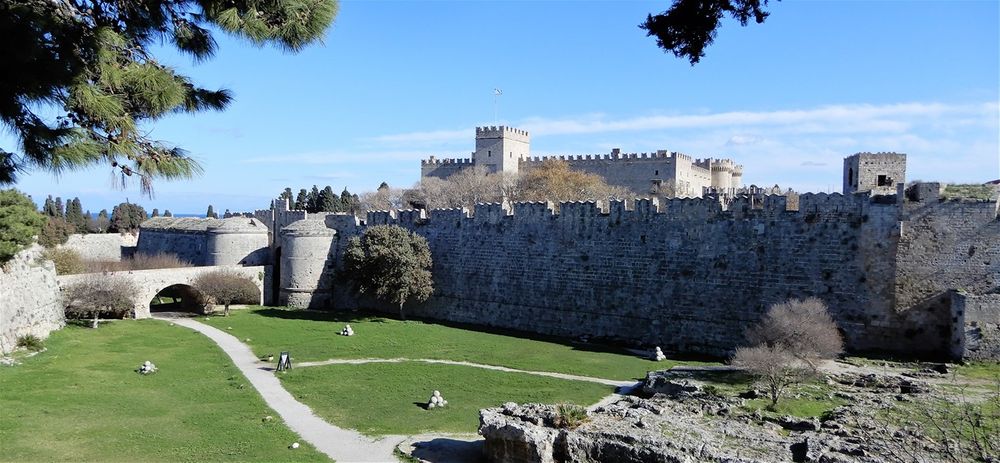
Prologue
Rhodos in winter.
The first time I heard about Rhodos was in late 70s, when my sister went there for a week with her classmates as part of an organized school tour. What I very much remember is that she brought an umbrella for everyone as a gift (!!!) and for me an azure Lacoste polo shirt…which I think was a fake. There was a huge Lacoste fake market in the area those days.
Umbrellas as gifts? Yes... Umbrellas were the popular souvenirs everyone used to bring back from his holidays on Rhodos those days…a tax break I suppose(?)… I am not sure. They still sell umbrellas at souvenir shops on the island, and certainly the reason is not the frequent rainfall!
When I told people that I am going to spend New Year’s holidays on Rhodos island, I got the same reaction from every single one: “what on earth are you going to do in Rhodos in wintertime?”
Well…. What on earth am I going to do in Rhodos in the middle of winter?

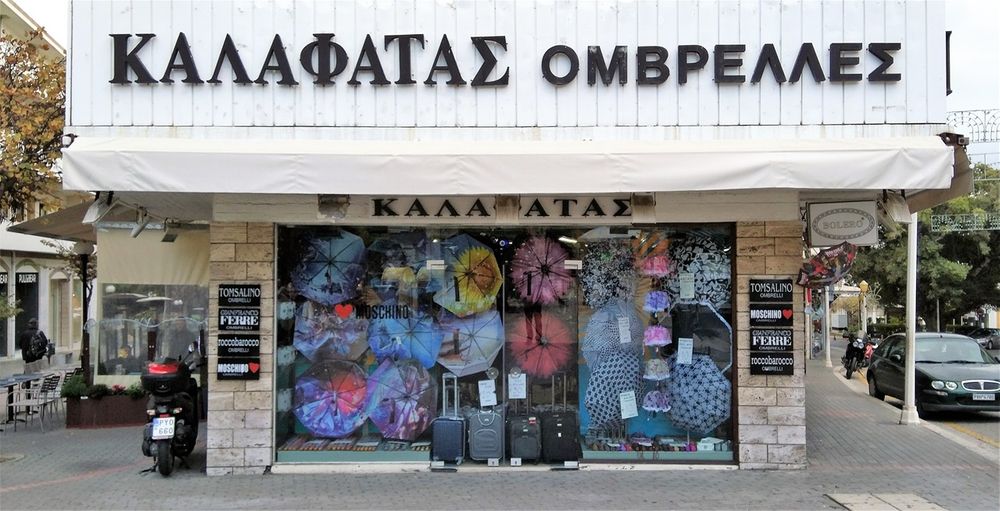
"Καλαφατας Umbrellas", a rhodian institution.
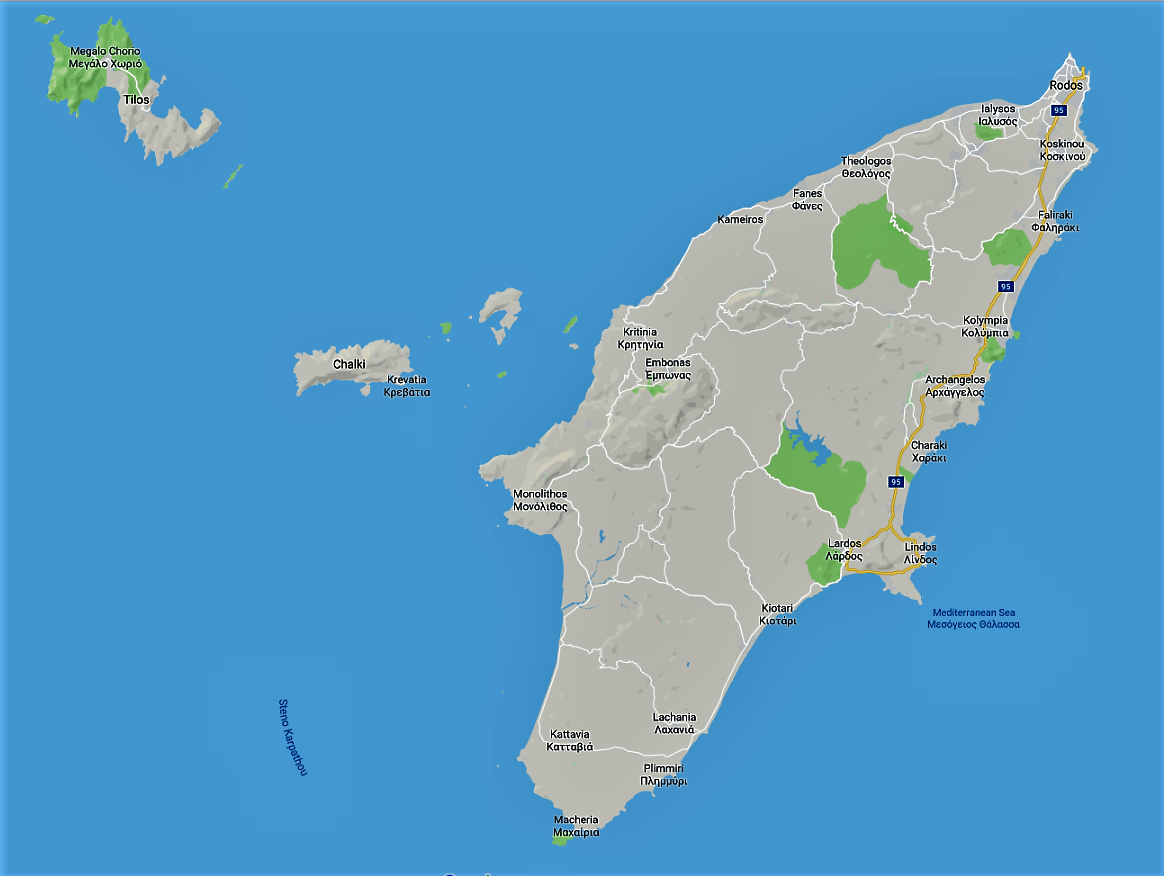
Rhodos Island. The Town of Rhodos is located at the very north tip of the island.
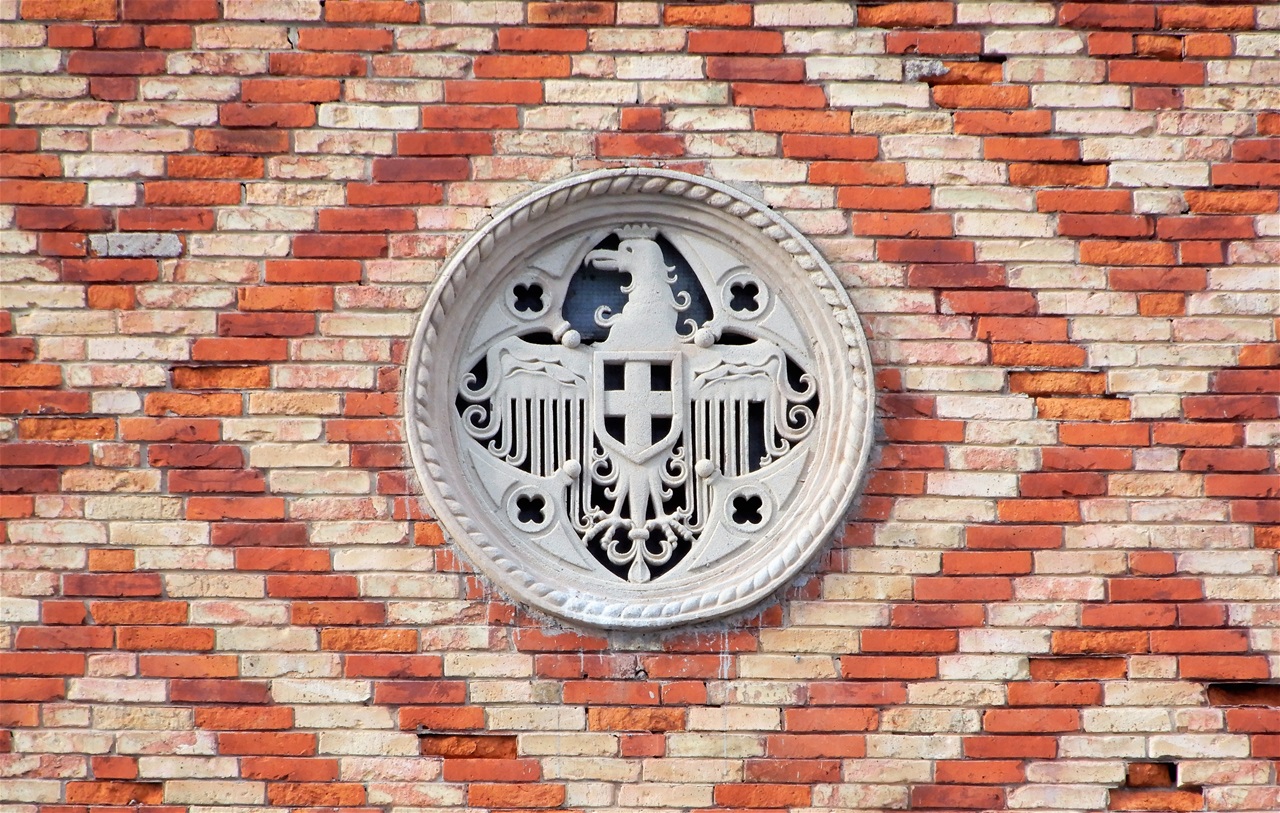
Detail of the easter facade of Palazzo del Governatore in Rhodos Town.
Orientation
Rhodos island (or Rhodes or Ρόδος) is a big island and there are lots to see and do.
Nevertheless, this long weekend and New Year’s Eve, I decided not to get far out of Rhodos Town at all.
The Town has a rather big population of about 60,000 inhabitants and a history that spans from the ancient times to modern days (from classical antiquity to Hellenistic ages and the Colossus, to the Byzantine period the crusaders and the Islamic rule, to the Italian rule and the union with mother Greece in 1947), so there are so many things to do and visit in the city itself.
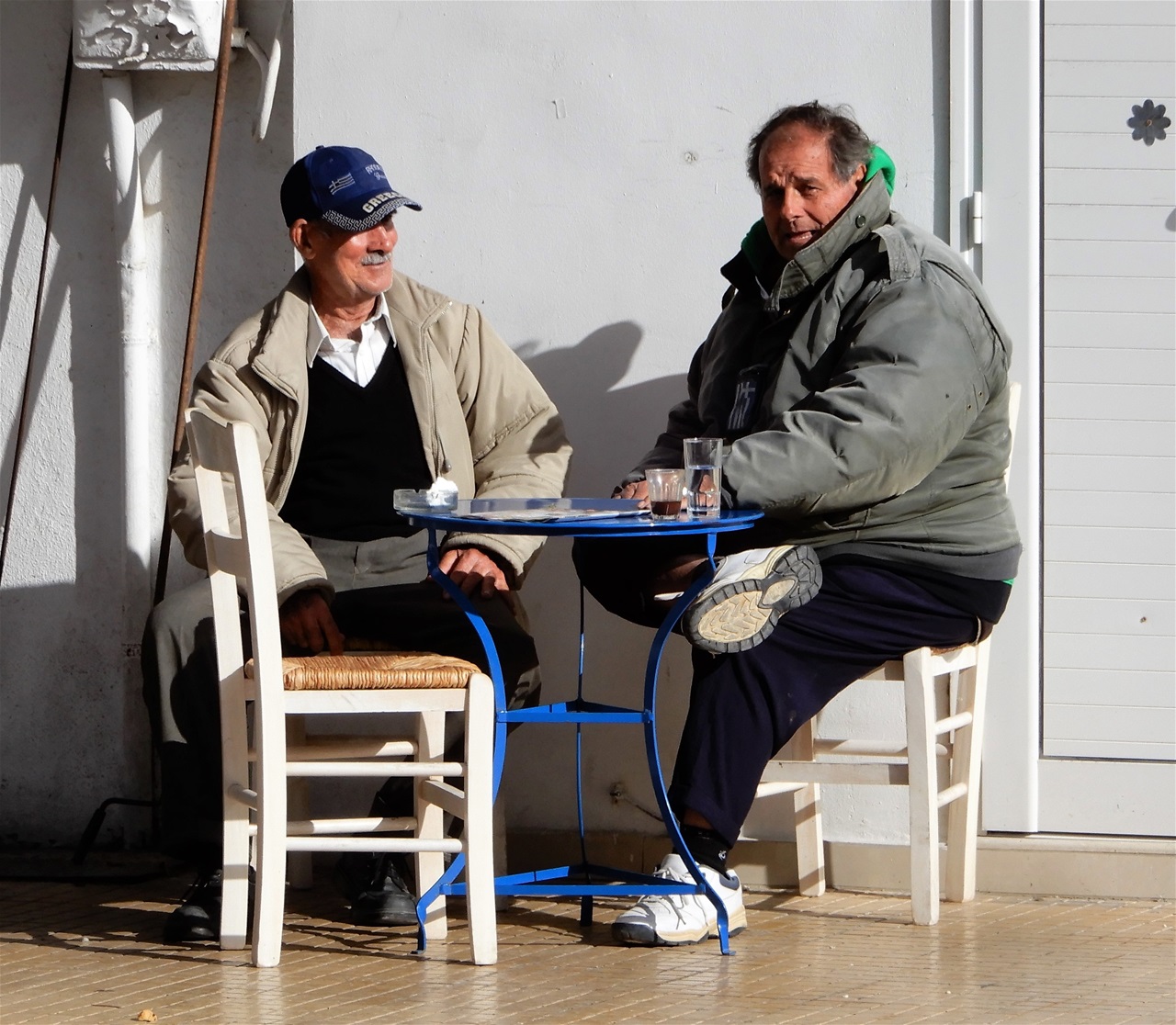
Relaxing in winter time.
Therefore, from my sister I heard all about the “Island of the Knights”: the castle town, the beaches, the Italian style buildings, the valley with the butterflies…everything.
Everything? I believe castles were not really what she was interested to. You see, those were the 70s and it was her first long stay away from home. I can only imagine.😎
The next time Rhodos came into my life was some 10 years later, when I visited the island as a student. To tell you the truth, the things really stack in my mind from that trip around the Dodecanese islands has nothing to do with the touristic attractions at all: I remember a 22-hours boat journey from Pireaus to Rhodos, sleeping on the floor of the upper boat deck (next to the big buoy) and a long night sleep under the stars at the island port waiting for the boat back home (in a blue outside and red inside sleeping bag (*)).
Since then I have visited the island several times for long weekends and a couple of times on business trips. But never during winter!
(*) My friend Maria on that trip had exactly the same sleeping bag as mine, but that was red outside and blue inside... long live the boy-girl stereotypes! 😀
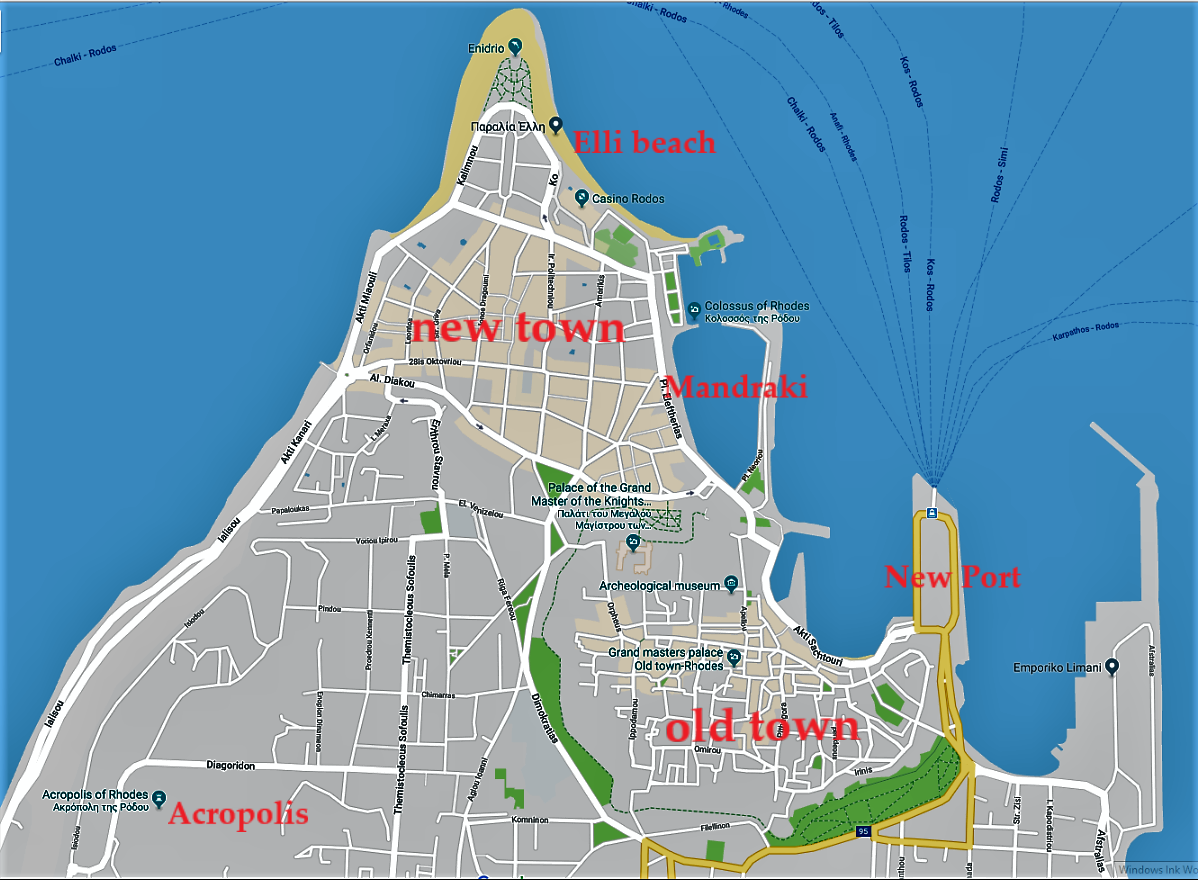
The Town of Rhodos.
Certainly, the options you have are limited compared to the ones during the summer period: most of the restaurants are closed in winter, as well as most museums and places of interest. On the other hand, the restaurants which stay open, are the ones that cater for the locals, so you have better food for a better price. The most important, though, is that you can have long tranquil walks, something impossible to do during the hectic summer months, when you bump onto other tourists all the time, or compete with them to catch the last available restaurant table.
For the traveler's interest, Rhodes Town falls into three distinct areas:
❤Rhodos Old Town, still enclosed by its medieval walls,
❤Rhodos New Town, north and west of the Old Town, which includes the New Port (the Commercial Harbor), Mandraki (the yacht and ferry harbor) Elli Beach & the Casino, and
❤Acropolis of Rhodos, the ruins of the ancient city.
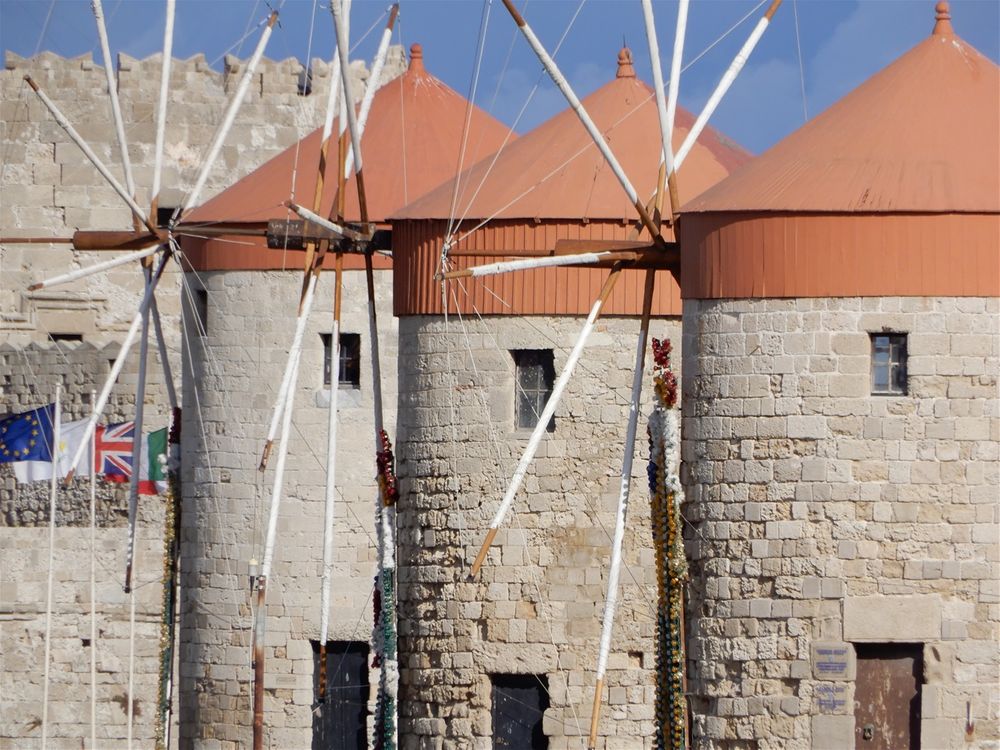
The three windmilles at Mandraki port.
Ladies and gentlemen this is one of the most fascinating places in the Mediterranean Sea, a history book of its own, one of the most beautiful islands.
This is Rhodos!
Arriving on the island
“Diagoras” International Airport is the main gate to the island. Even during winter months, there are several flights connecting the island to Athens. The flight lasts only 45 minutes. Needless to say, that from March till October the island is served by many charter flights from all over Europe and the Middle East. There are also scheduled air connections with other Greek islands in the area: Kos, Kastellorizo, etc.
The airport is located 14 km south of Rhodos Town and there is a good bus and taxi connection to it. The bus to the city costs 2.6 euros and the ride lasts 30-40 min, depending on the traffic. The taxi costs 25 euros, which is a real rip off for a 20-30 minutes’ drive. Nevertheless, if you want to explore the whole island, you should hire a car which is much cheaper and more convenient than the taxi… unless you feel unconfortable to drive “the Greek way”.
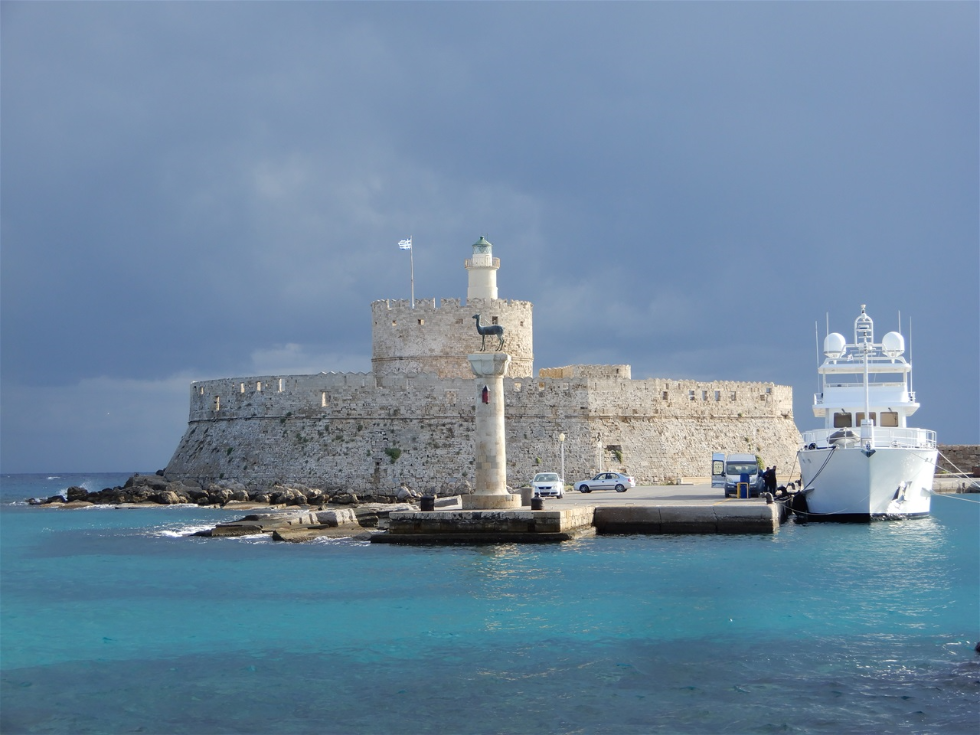
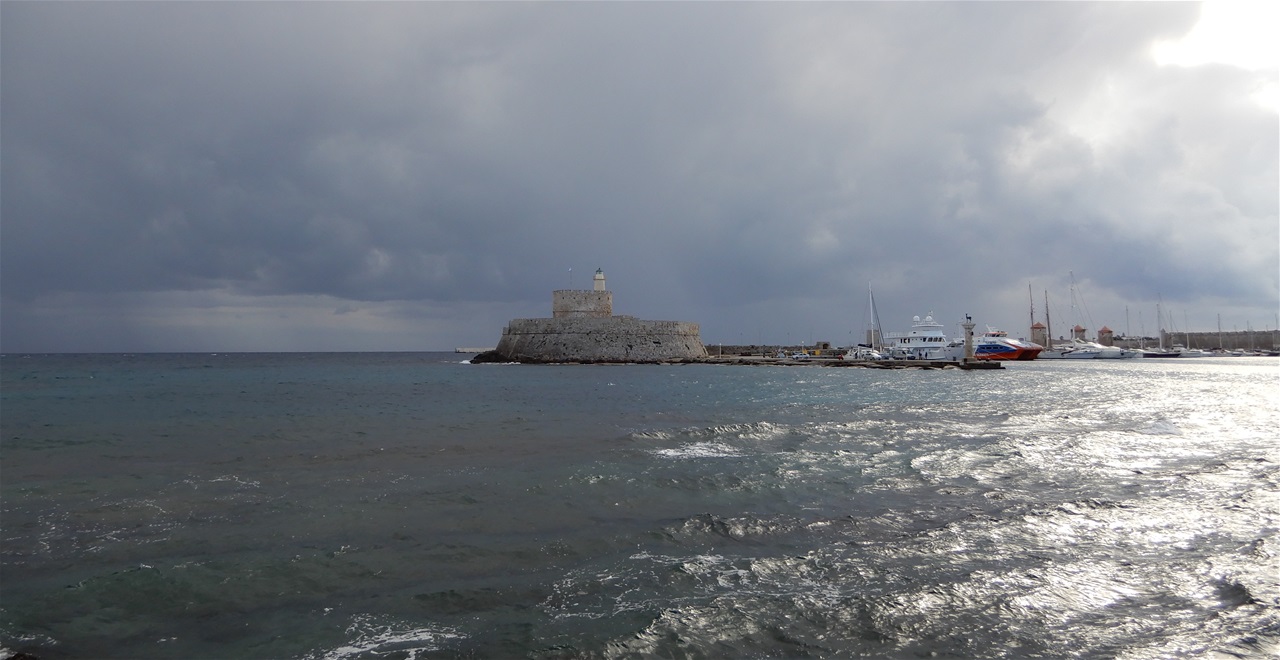
Fort of Saint Nicholas, at the entrance of Mandraki port.
We arrived on the island very early in the morning. We checked in to our room the moment we arrived, so we were free to explore the island.
The weather was not ideal for walking, but there were so many umbrellas to buy!🙂
Note
I decided to include a lot of history and architecture information in the description of this trip. This may not be of much interest to every reader. So, this extra information is given in the following text in "italics" bracketed like this: ❤text💔.
In this way, it is easier for the reader to leave out "unwanted" information.
DAY 1
The New Town
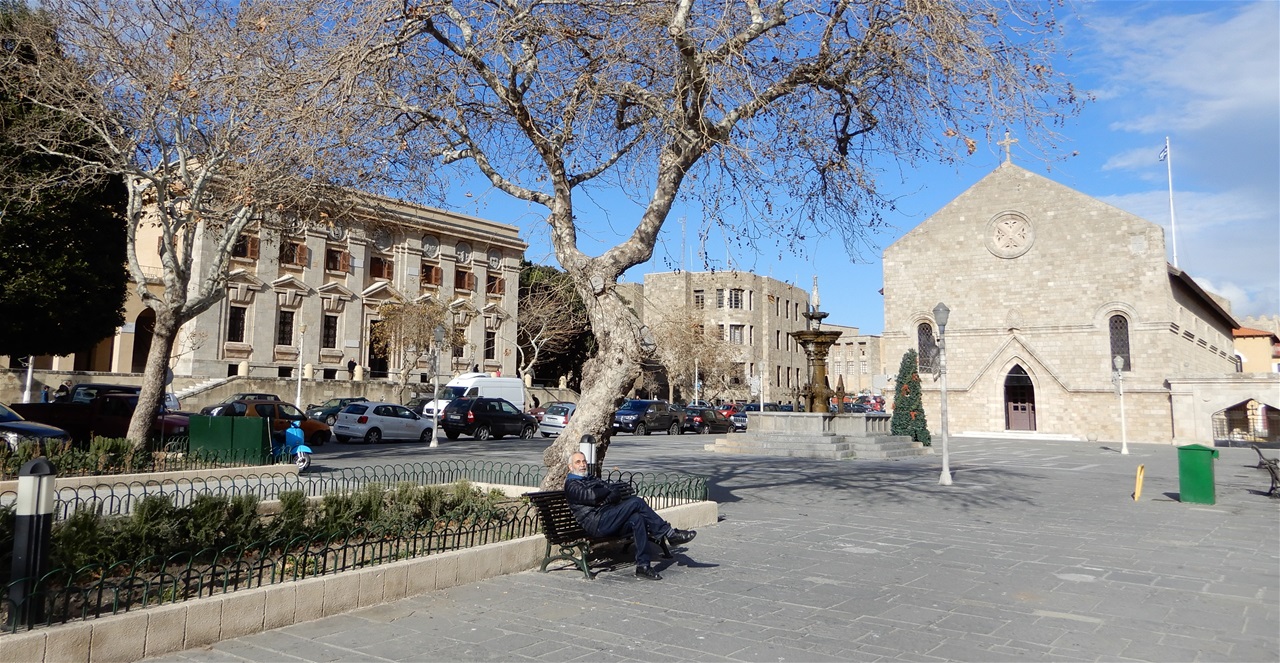
The square in front of "Evangelismos" church, at Mandraki port.
The “New Town” is the part of the town spread outside the walls and covers the northern most tip of the island. Most of the bigger hotels are located there, as well as lots of restaurants, bars, cafes and commercial shops.
The town would be a typical modern Greek, colorless and chaotic city if the Italians throughout their occupation of the island did not elaborate it with beautiful, lavish, public buildings. Rhodes was “the crown” of the “Italian islands of the Aegean" ("Isole Italiane dell' Egeo”).
The Italians gave to the city a plan expounded with beautiful parks around the walls and public buildings. It was the Italian Governor Mario Lago (1924–36) who was responsible for the commissioning of a comprehensive new Master Plan for the expansion of the city of Rhodos outside the walls, which was entrusted to the architect Florestano di Fausto and approved in 1926.
The Master Plan envisioned the development of an area (already partially used by the Ottomans for administrative buildings and large residences) to the west of the port of Mandraki, between the Old City and the northern tip of the island. Against the theatrical background of the City of the Knights, with all its convenient associations of a Latin dominance, a new “Foro Italico” of commercial and administrative buildings was to be spaciously laid out along the shore.
Associated with this plan for the city was the wider project for the construction of new streets and roads and in the frame of this plan the Italians demolished the Ottoman period houses, that were built in and around the city walls, and “restored” the Medieval City to its pre-ottoman status.
The buildings at the Mandraki front are in use even today as city and prefecture public buildings. I have to admit, that nothing has been really done to the city after the Italians handed the islands to the Greeks, besides the construction of unimaginative buildings made of concrete.
I should not be misunderstood though, Rhodos town is a very pleasant medium size city with lots of cafes, restaurants, commercial shops and little green spots where usually a huge ficus tree dominates the place with its grandeur and thick shade.
Italian Colonial Architecture in the Dodecanese
❤The Italians sought to give a unifying architectural stamp to the Mediterranean and African territories which they occupied in late 19th and early 20th centuries.
They occupied the Dodecanese from 1912 to 1943. At first, they tried a new, pan-Mediterranean, "Rationalist" architecture which, by incorporating different elements of local traditions (Greek, Roman, Venetian, Ottoman, middle eastern & north African Islamic), was intended to give the visible impression of the extent and diversity of the new empire. This gave rise to the period’s greatest and most imaginative buildings. This period corresponds to the period Mario Lago (1924–36) was Governor of the Dodecanese. But it was to prove a short-lived architectural springtime.
After 1936, with the new political Governor, Cesare Maria de Vecchi, (who had formerly been Mussolini’s Minister for Education), and the declaration of the Fascist ‘Imperium’, architecture had to turn to more austere forms following the demands imposed by more authoritarian politics. Some of the earlier buildings were even purged of their decorative elements in a ‘purification’ of the colonial architecture. Such an example is the “Grande Albergo delle Rose”, which ‘purified’ of its decorative details and ‘arabesques’ to reveal a stern, more serious core in unadorned ‘poros’ limestone (the building took a form similar to that of the present day). Fortunately, many more of the early buildings have survived throughout the Dodecanese than the later ‘purified’ ones.💔
A walk of Italian architectural splendor
Start your Italian architecture walk at the “Therme Park” (in Diakou str.), which was once part of the luxury "Thermae Hotel".
Today the hotel houses part of the “Rhodos College for Hospitality Management”, and its gardens have been converted into a park, the biggest part of which is occupied by a modern complex of restaurants and bars. Leave the park behind you and walk in Sofokleous Venizelou str. for a couple of blocks till you reach “Akadimias Square” (Πλατεία Ακαδημίας). On the square there are two important buildings of the Italian colonial era: the Men's High School ("Scuola Maschile"), which today houses the «Teachers Training College of Higher Education», and just opposite of it, an eclectic building built in 1928 to house the “ItalianYouth Club” and which today accommodates the "Rhodos Scout Club".
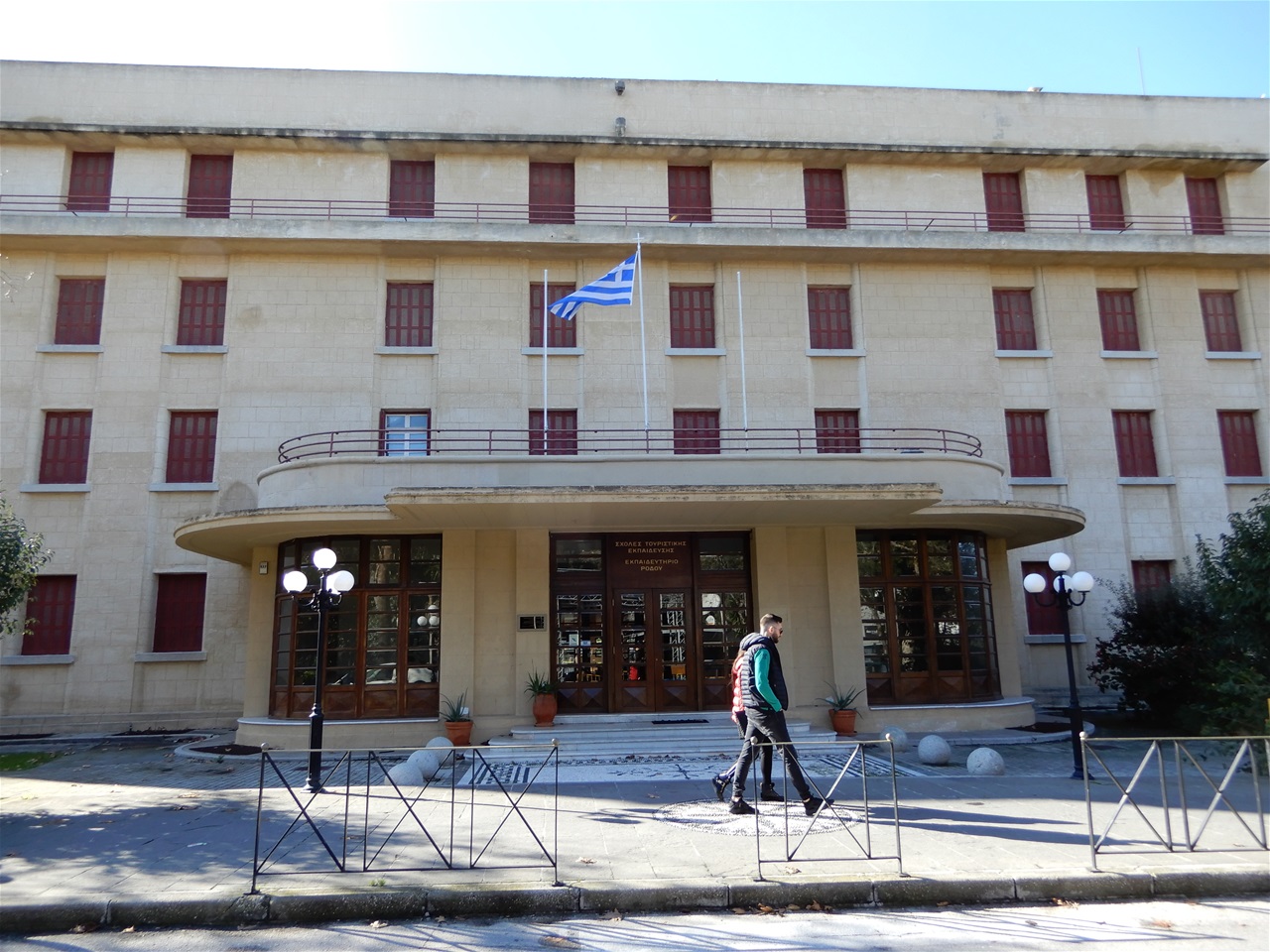
“Rhodos College for Hospitality Management”, opposite Therme Park.
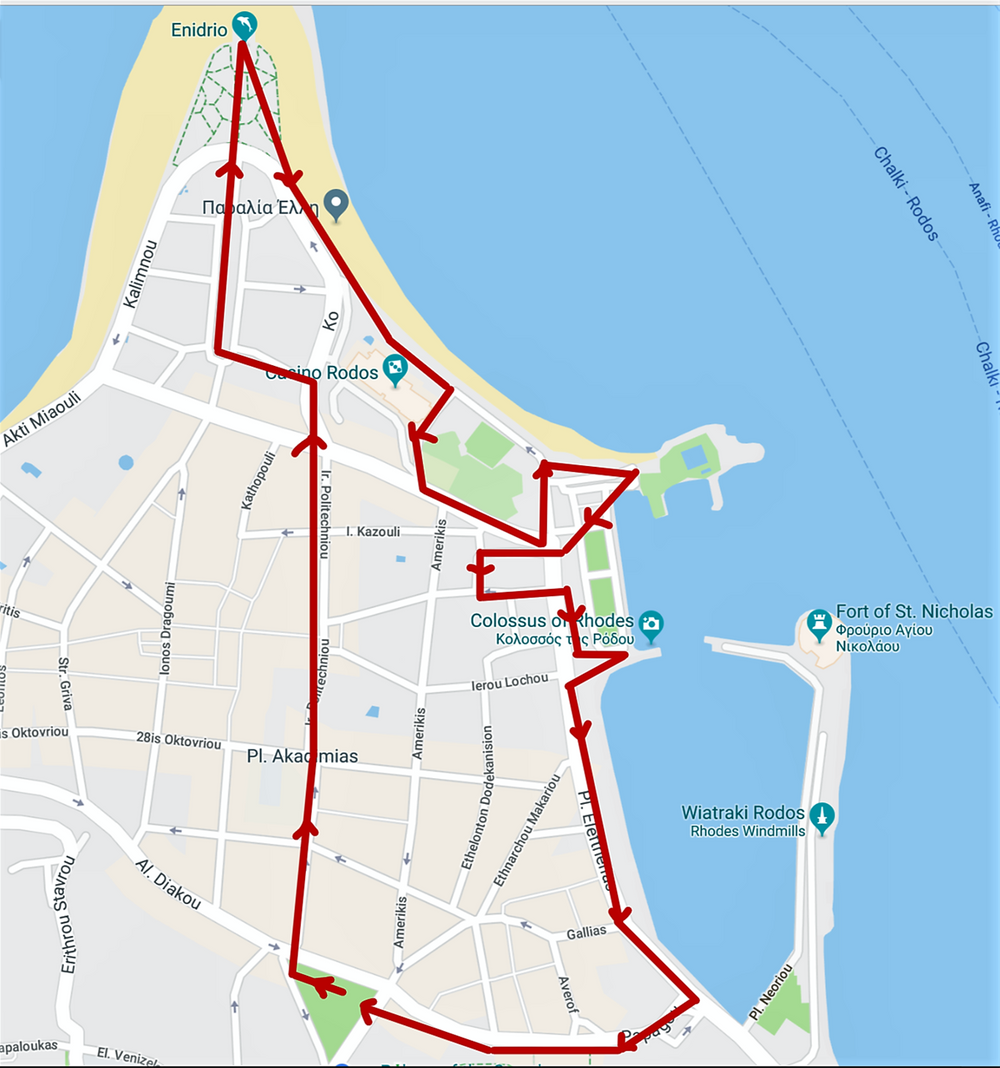
A walk in New Town.
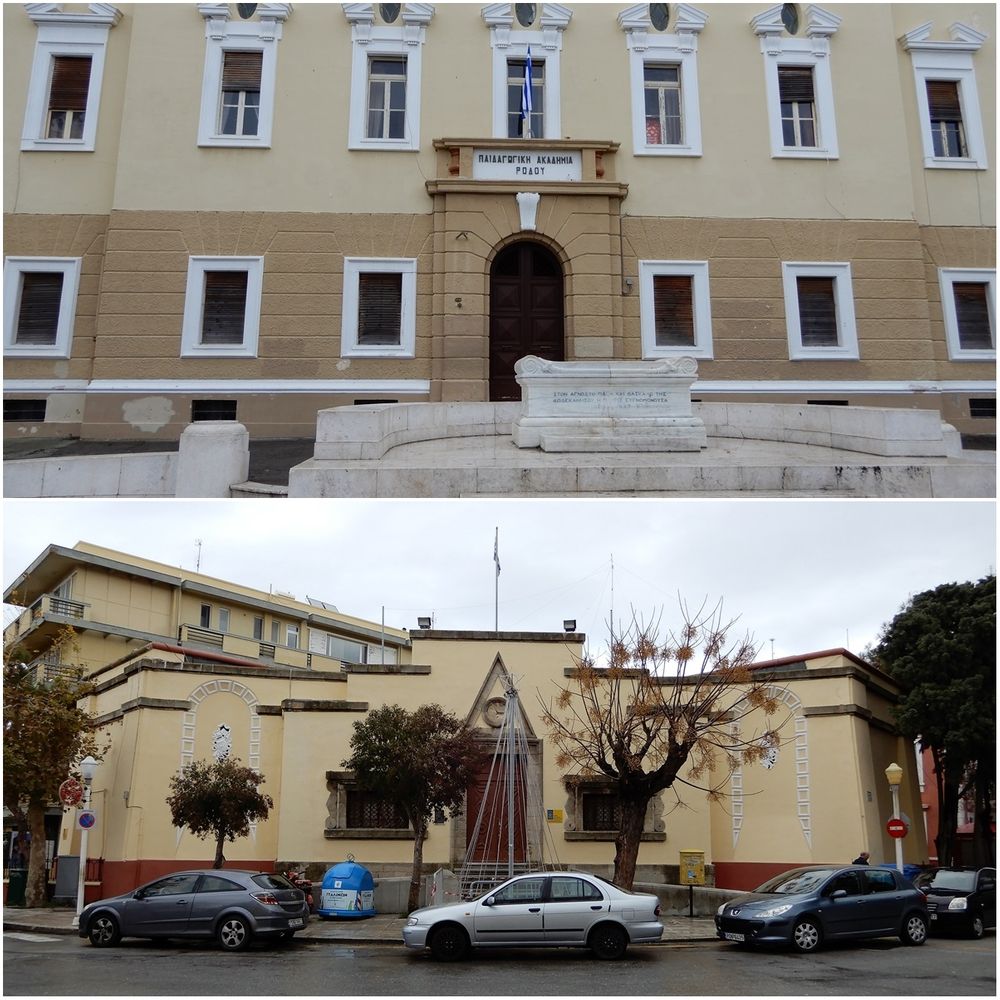
"Squola maschile" (top) and "Italian Youth Club" (bottom).
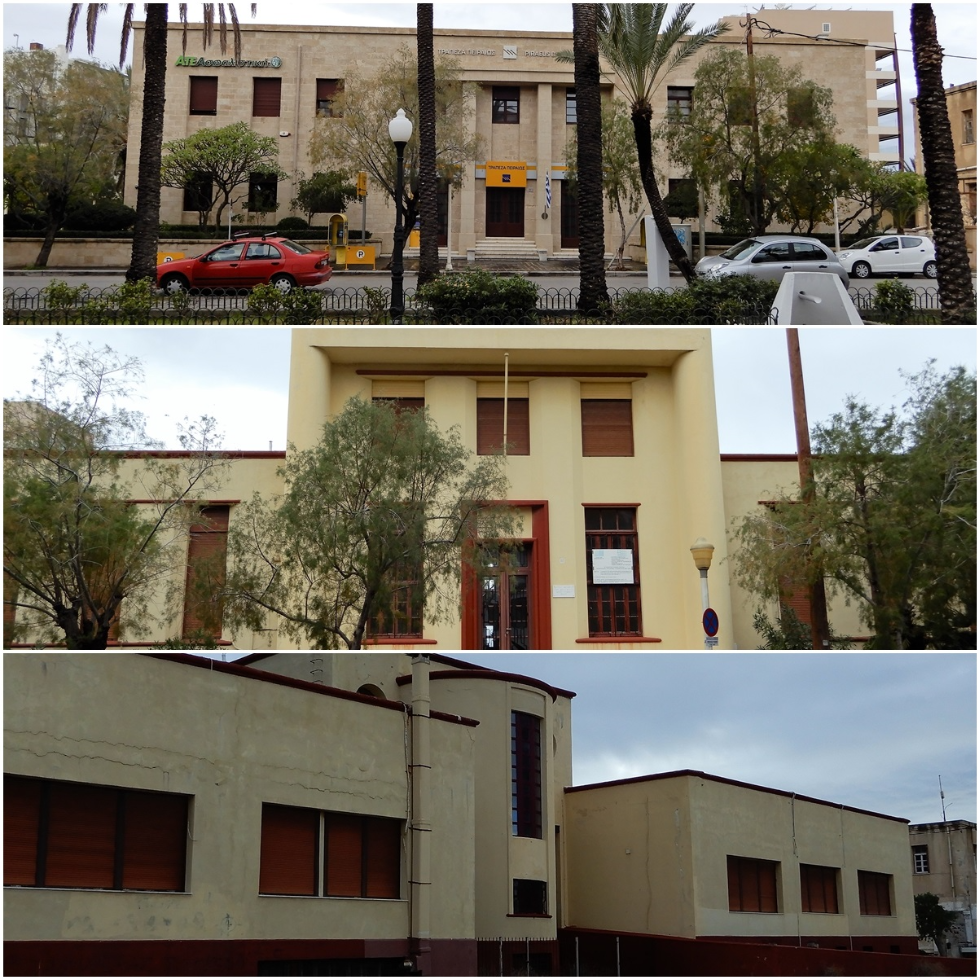
Italian architecure at "Gavriil Charitou Square".
The Aquarium is an Art Deco building designed by the Italian architect Armando Bernabiti and it was constructed between 1934 and 1935.
❤When the Aquarium first started operations in 1937, it was named the "Reale Istituto di Ricerce Biologiche di Rodi" (Royal Biological Research Institute of Rhodos). Research included the hydrology, sponges, and fisheries of the Aegean.
Continue north till you reach the main entrance of the Casino.
Turn left on Kastelorizou street to reach the "Gavriil Charitou Square" (Πλατεία Γαβριήλ Χαρίτου). Around this elongated square, lined with palm trees, there are some excellent samples of “Italian colonial” architecture: namely, what is today a Bank as well the under renovation buildings next to it.
Stand on the long axis of the square and look north to see the "Enidryon" (Aquarium & Museum of Marine Life) framed by two huge modern hotels in the foreground.
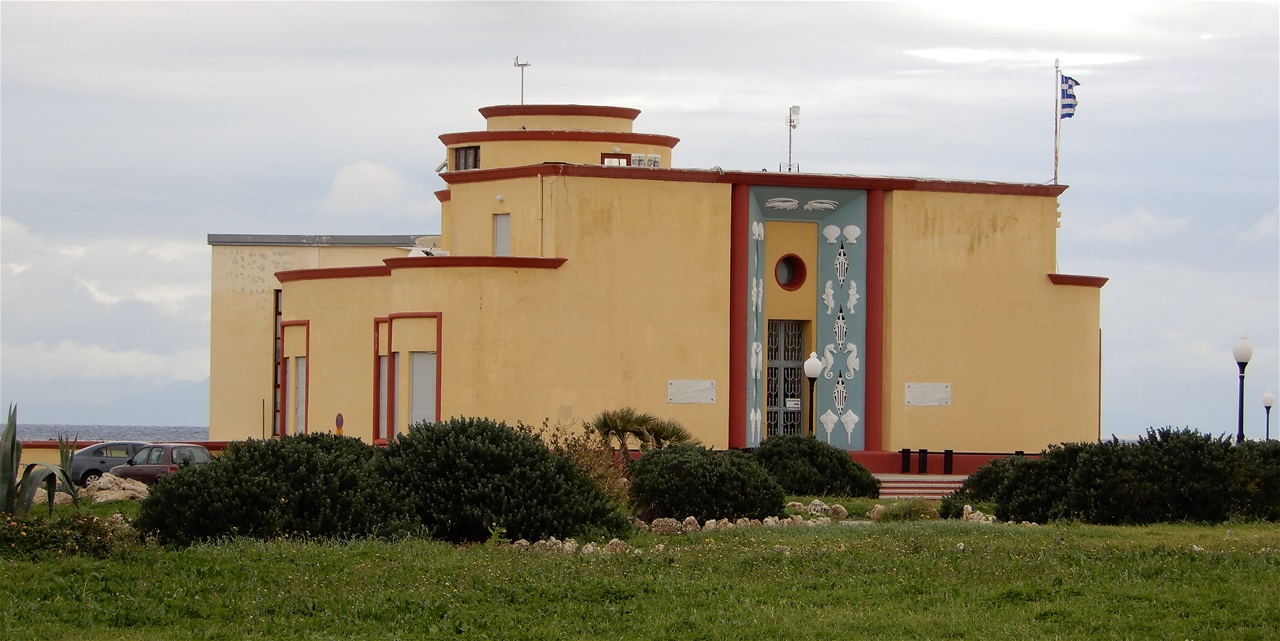
The Rhodos Aquarium.
When the island handed back to Greece, after the WWII, the facility was operated as part of the "Hellenic Hydrobiological Institute". Since 1963 it has been known as the "Hydrobiological Station of Rhodes", and is administered by the National Centre of Marine Research. An exhibition area was added to the north side of the building in 1971–72.💔
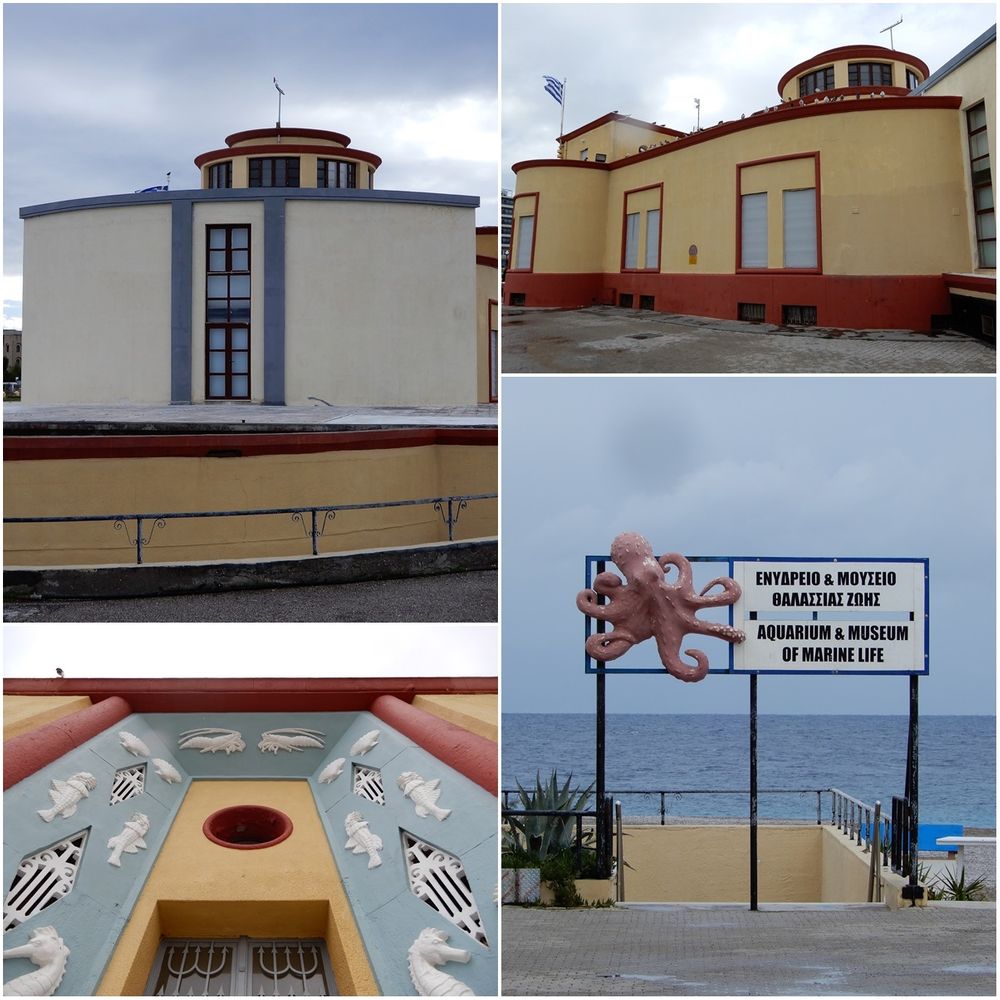
The Rhodos Aquarium in a grey winter day.
In front of the aquarium, there is a huge open space, the “Enidryo Square” (Πλατεία Ενυδρίου). At this point you have a 360 degrees view of the northern tip of the island.
The aquarium is surrounded by sandy beaches. The one on the east side is the famous “Elli beach” (Παραλία Ελλη) and the one on the west is the "Akti Miaouli Beach".
Continue your walk along the Elli beach southwards (towards the city).
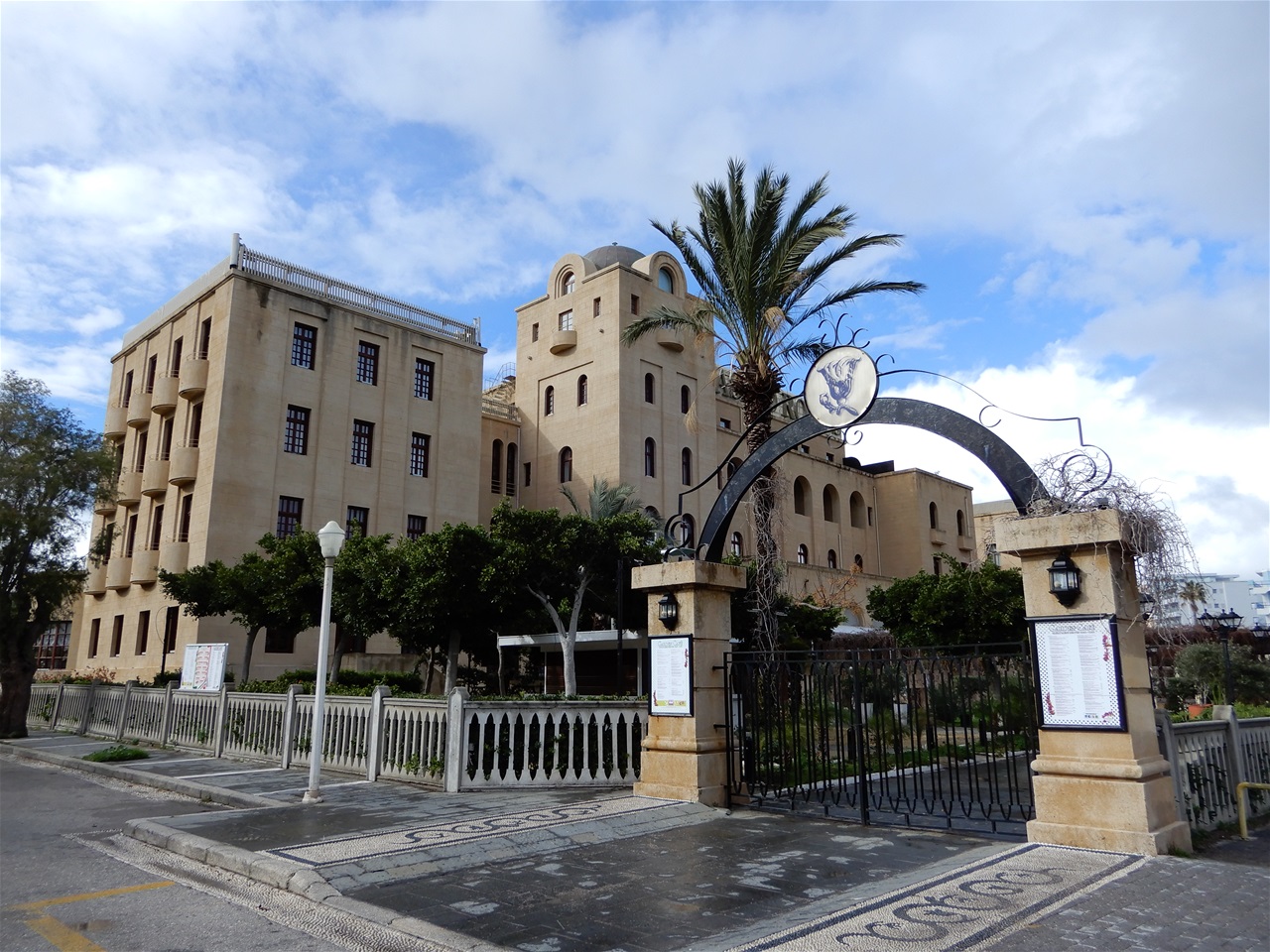
The Rhodos Casino.
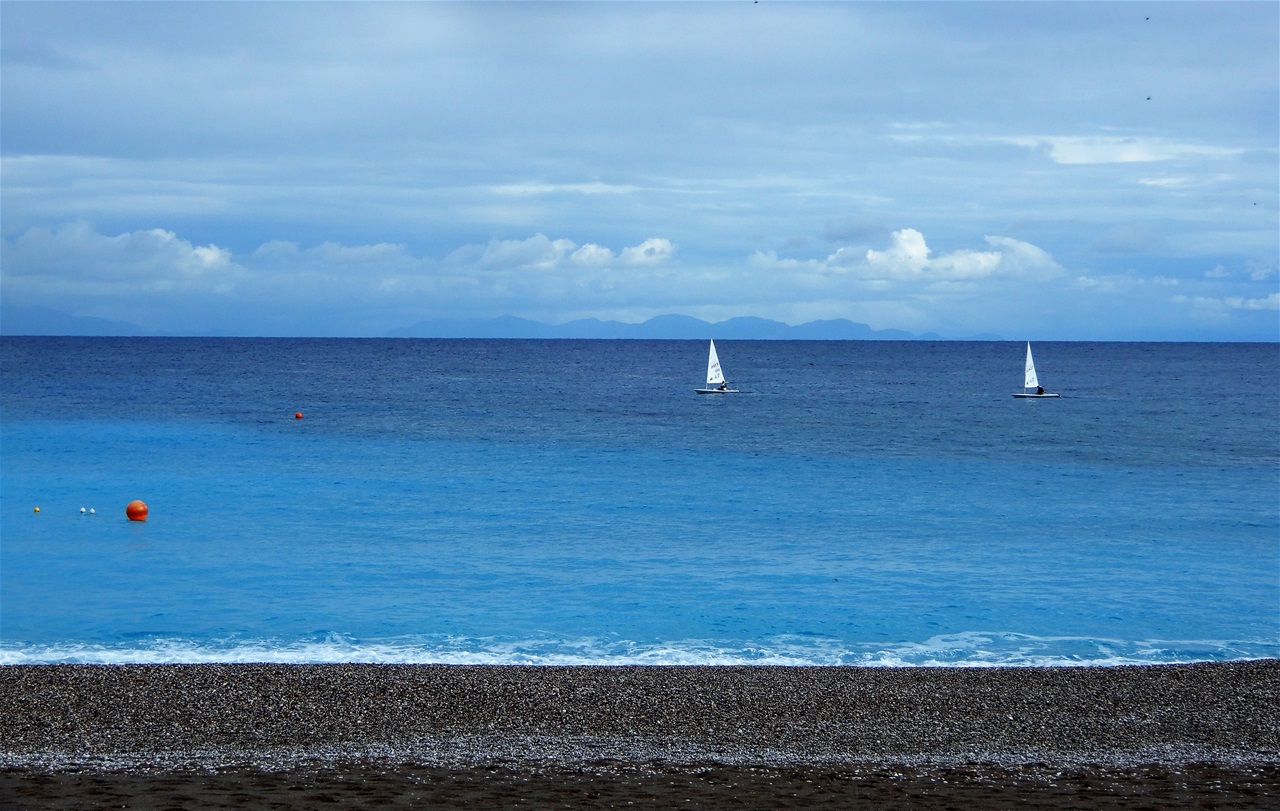
Elli beach in winter.
From Elli beach you can clearly see the Turkish coast of Asia Minor, while on your right hand you pass by the “Rhodos Casino”, a luxury hotel which opened its doors in 1927 as “Grande Albergo delle Rose”.
❤The hotel changed hands several times and eventually closed in the mid-70s. The building renovated and opened again in 2002 as a Casino and hotel. Throughout the years royalty, statesmen and other prominent international figures have walked through the imposing front doors, including Greek prime ministers Eleftherios Venizelos, Konstantinos Karamanlis and Georgios Papandreou, the Greek shipping magnate Aristotle Onassis, British Prime Minister Winston Churchill, and the Israeli Minister of Defence Moshe Dayan.
Its lavish premises have housed events of great historic importance, most significantly the 1948 signing of the foundation of the State of Israel.💔
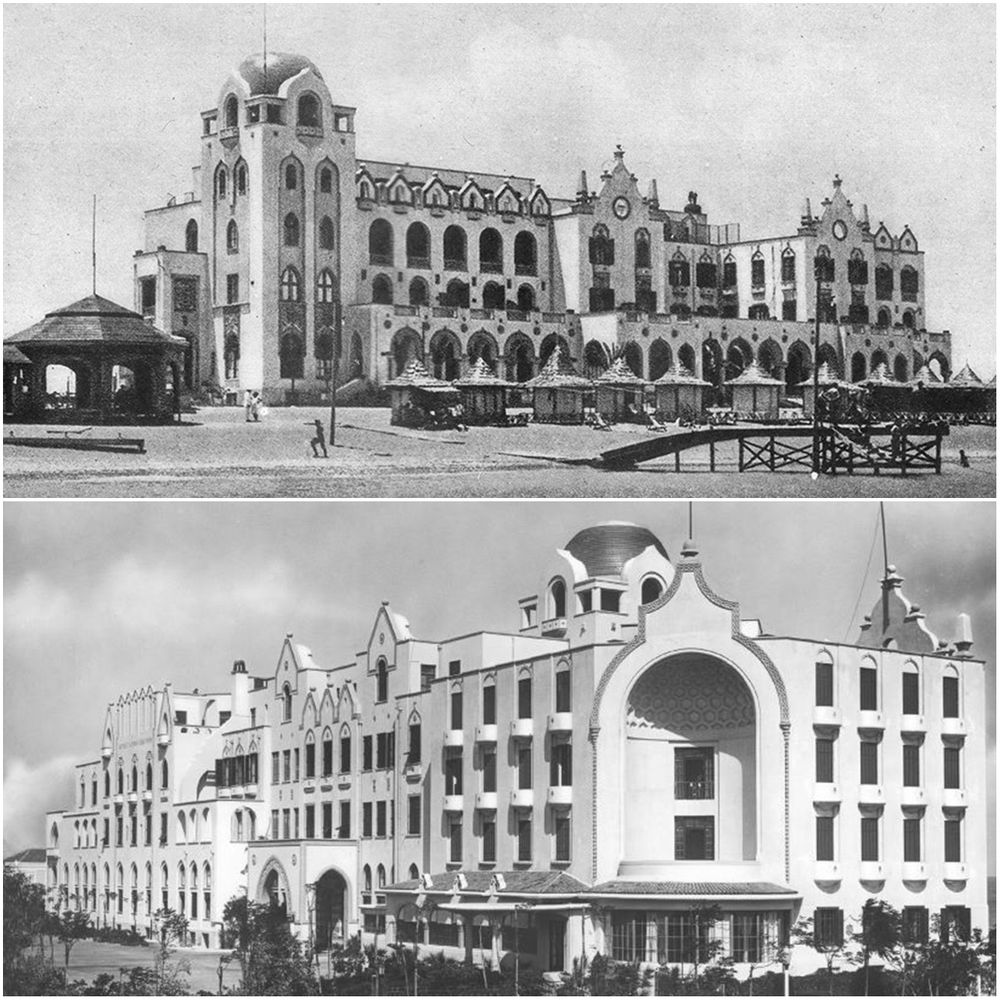
The “Grande Albergo delle Rose” in its original form.
Next to the Casino is the Rhodos Tennis Club, just behind which stands the “Mourat Reis Mosque” and its neglected garden and ottoman cemetery. The Murat Reis Mosque is one of the oldest mosques on the island, built less than a year after the Ottoman conquest in 1523.
❤The mosque was constructed on the site of the Aghios Antonios church next to the cemetery of the Knights. The exterior of the mosque boasts an ornate minaret from which the call to prayer has been heard down through the centuries. The mosque is named after Murat Reis, who is buried in the cemetery within the grounds. One of the Ottoman Empire’s most successful naval commanders, he was also considered by many to be one of the most important Barbary corsairs. For centuries sailors visited his tomb at the mosque seeking good luck at sea. He was later in life relieved of his post by the Ottoman Sultan presumably because of his sarcastic poetry. 💔
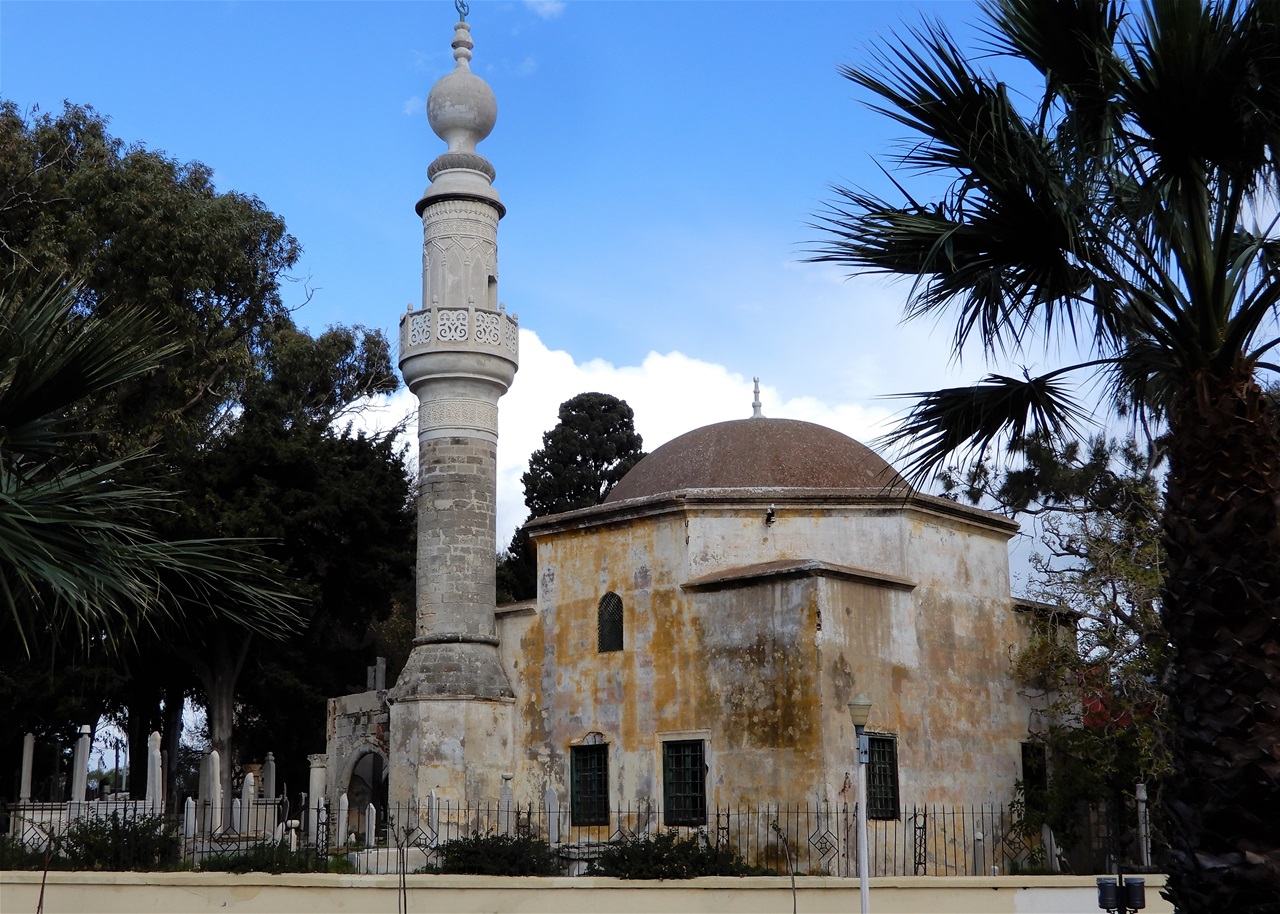
The Mourat Reis Mosque.
It is pity that the surrounding grounds of such an important monument has been left in despair.
The entrance of the mosque and the gardens is on Kountourioti Square.
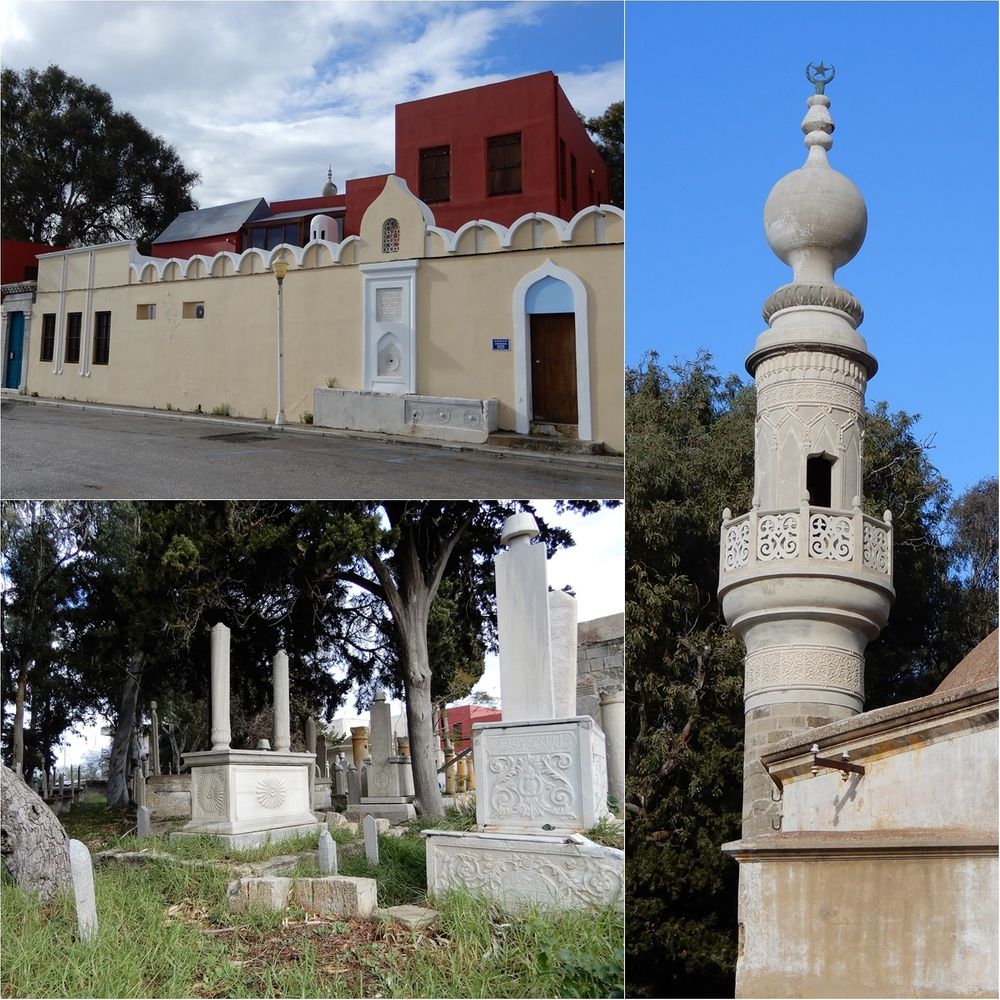
The Mourat Reis Mosque: Tekke Murat Reis ottoman complex entrance (top left), the Ottoman cemetery (bottom) and the minaret (left).
At the south-west corner of the Ottoman cemetery, behind the Tennis Club stands "Villa Kleobolos", a kiosk-like house, where lived the philhellene and friend of Rhodos poet and novelist Lawrence Durrell for two years (from 20/05/1945 to 10/04/1947) with his future wife Eve Cohen. So for his fans this is a "must visit" place.
Durrell held the post of Information Officer in the British Military Administration of the Dodecanese.
❤ In the spring of 1945, Durrell, ''speechless with gratitude'' upon taking his first swim in the blue Aegean, realized that ''space, light and solitude will have to be rediscovered again here, in all their ramifications.'' ''Reflections on a Marine Venus", Durrell's account of ''two lucky years'' spent on Rhodos, published in 1953, became the first book of postwar Mediterranean travel, and the begining of a series of books, popular songs, colorful movies and tempting travel images from which the Greek tourist boom of the 1960's would emerge.💔
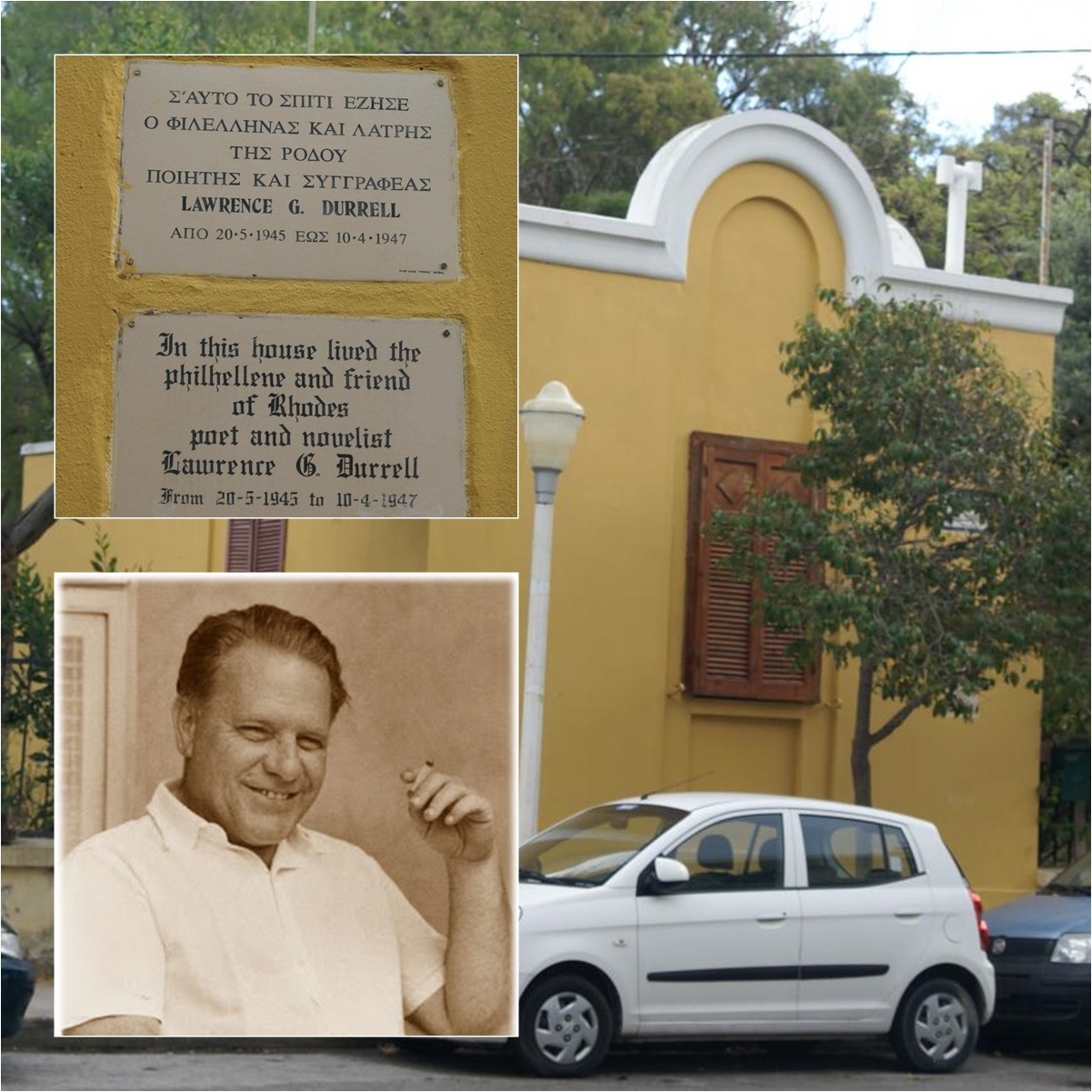
Villa Kleobolos where Lawrence Durrell lived for two years.
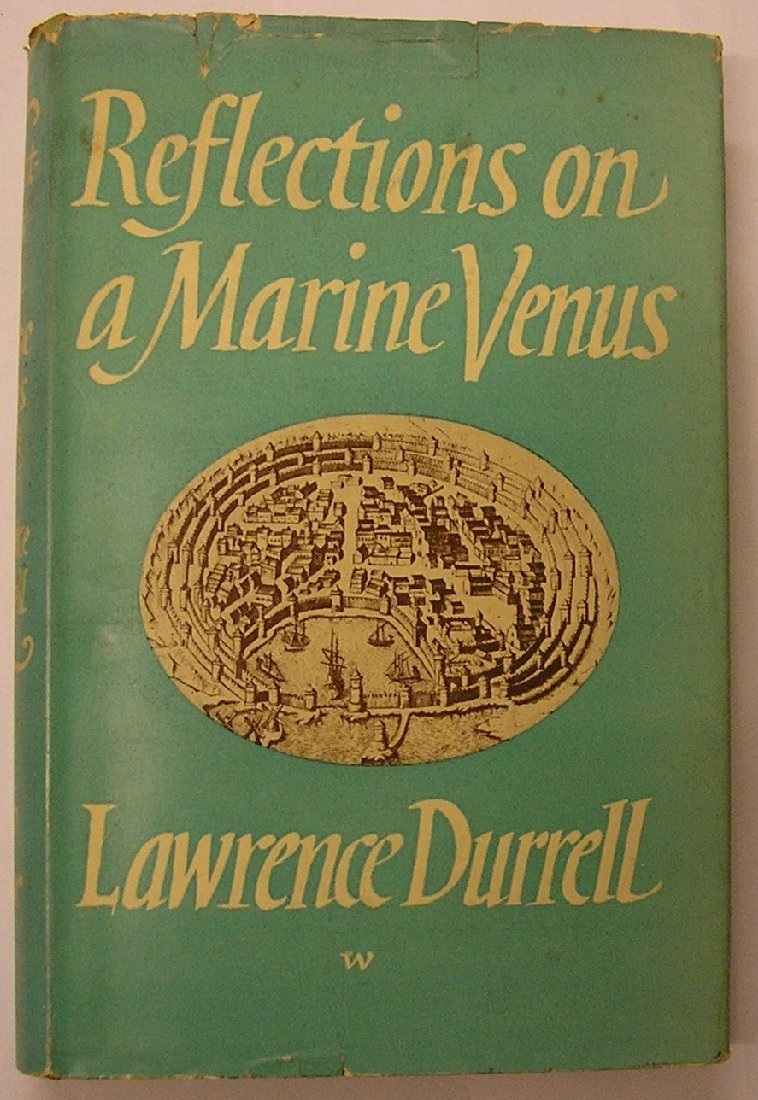
"Reflections on a Marine Venus". This 1953 Edition depicts the Old Town of Rhodos on its cover page.
Continue south till you reach "Kountourioti Square" (Πλατεία Κουντουριώτη), which today is a big open car parking.
The Square (formerly known as the "Piazza 23 Marzo") is surrounded by important buildings.
The "ELLI" structural complex is situated at the Punta della Sabia (known as Kum Burnu under the Ottoman rule), which together with the building of the Rhodes Marine Club (Yaghting Club & swimming pool) and the restaurant next door, delimits the square’s northern boundaries.
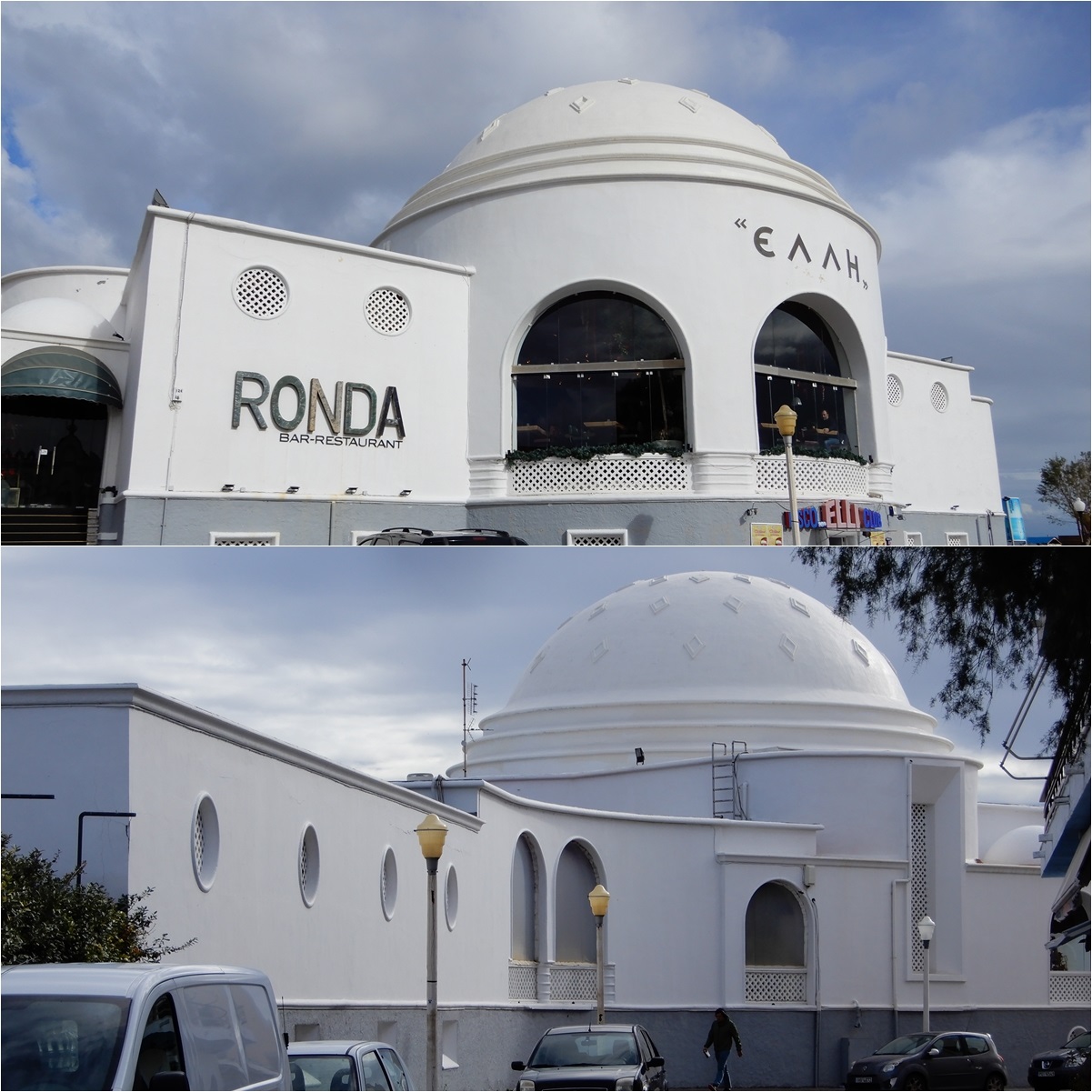
“La Ronda”.
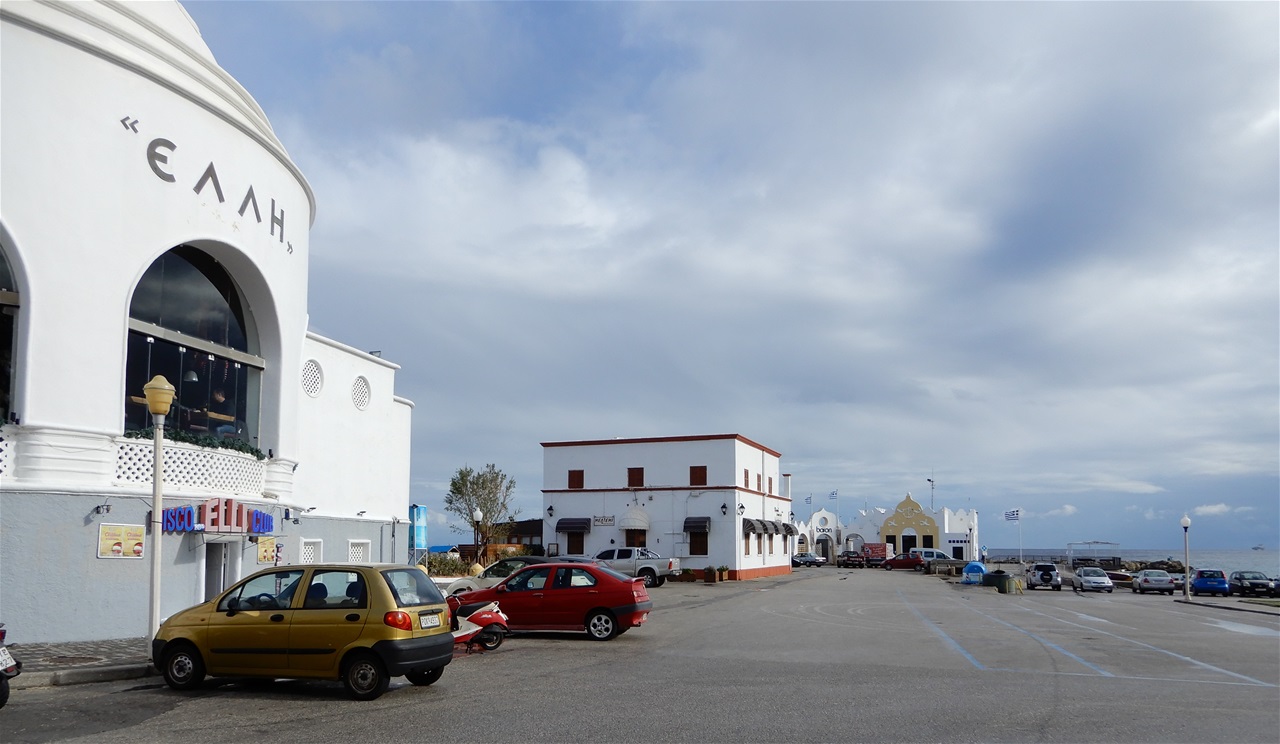
The "ELLI" structural complex in the foreground and the Yaghting Club in the background.
Westwards the square is bordered by the Tekke Murat Reis ottoman complex, eastwards by the seafront and southwards by the building housing the administrative services of the Prefecture of the Dodecanese (Palazzo Governale).
ELLI (Έλλη) (originally known as “La Ronda”) was built over the period between 1936 and 1938 on a project believed to have been elaborated by the Italian Architect Armando Bernabiti.
Together with the concrete diving board (trampoline) off the beachfront, it was destined to house a bathing facility and a snack bar.
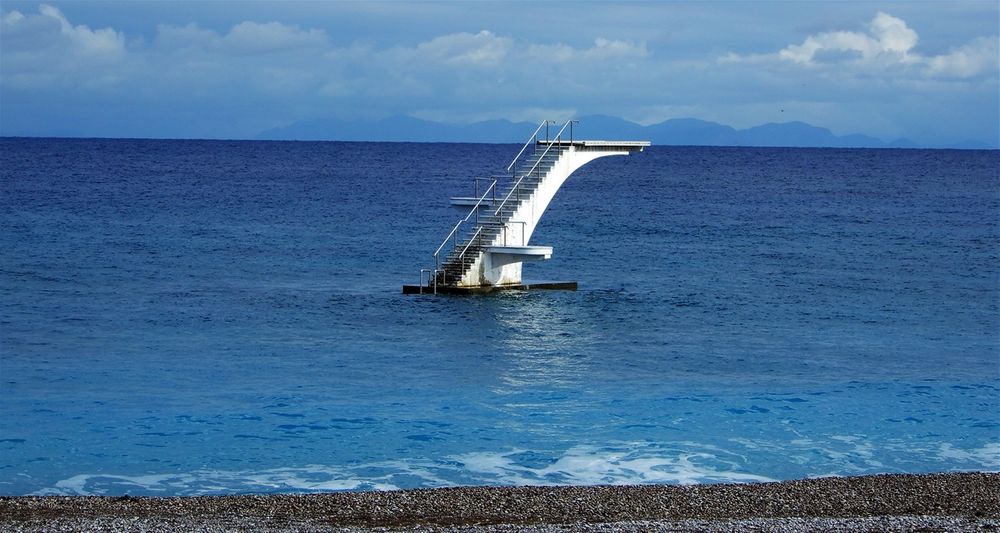
Τhe concrete diving board (trampoline) off the beachfront.
❤The complex itself is a statement of eclectic style, typical of the time of its construction albeit featuring several details perfectly harmonized with the “oriental” style. Striking is its voluble design perfectly adjusted to the environing area and the complex’s overall allure, the predominant feature of which is the circular hall (hence the original name of “La Ronda”), endowed with spacious arched window doors under a vaulted roof dotted with a multitude of small, lozenge-form skylights.
ELLI has come down in history as the most impressive example of bathing facilities. The ground floor was meant to be used for storage of canoes, boats and relevant gear as well as hosting a kitchen and a cloth-press, the whole connected to the upper floor through an internal staircase; the premises on both the ground floor and the upper floor of the northern wing harbored the lockers.💔
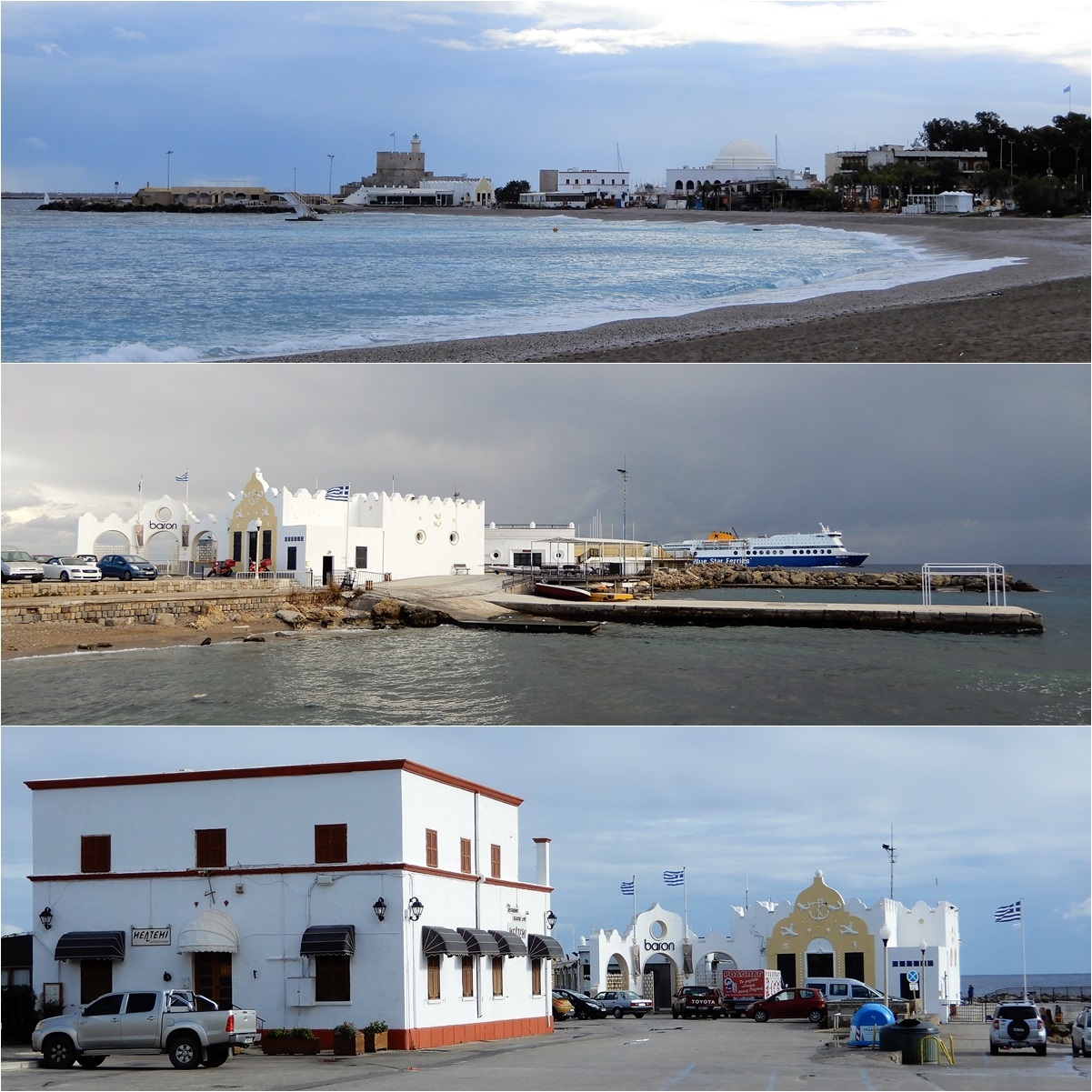
(top) Elli, Yaghting Club and the Fort St Nicholas seen from the north (Elli beach). The Rhodos Marine Club seen from Mandraki (middle). The Rhodes Marine Club (bottom).
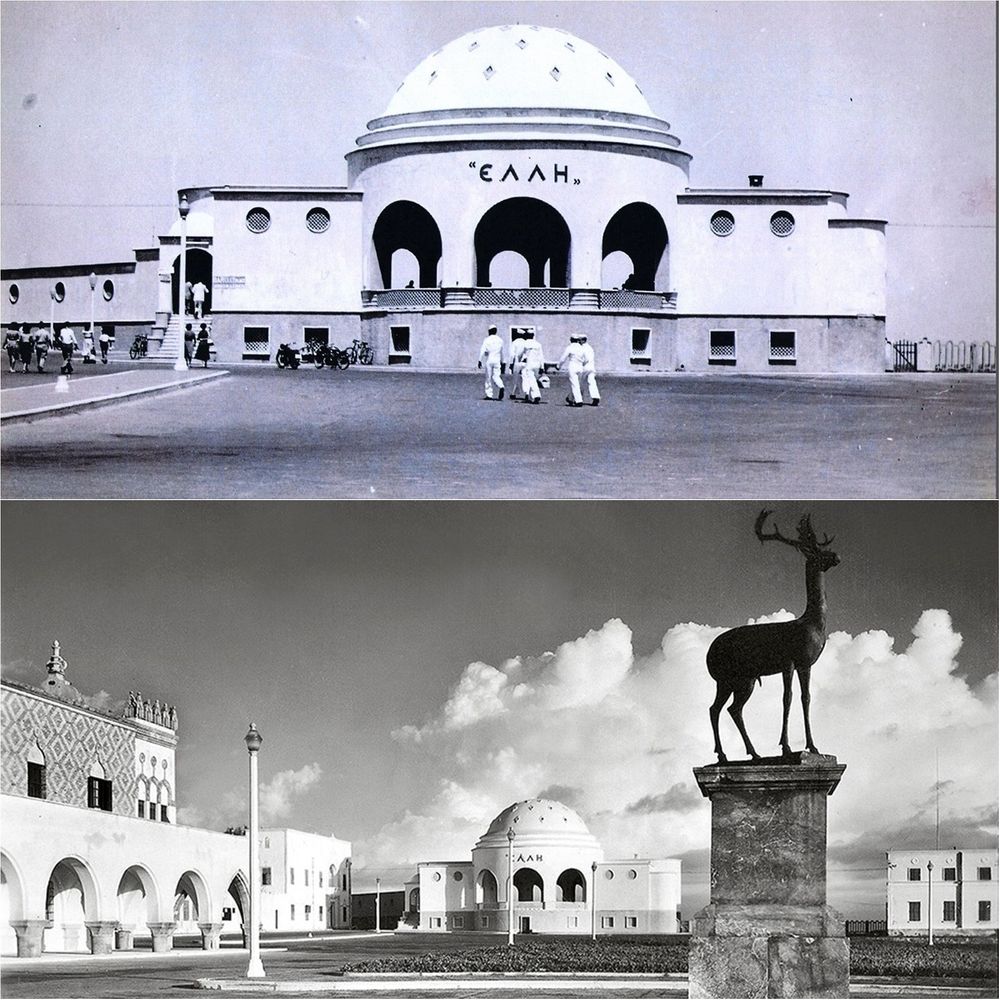
Old pictures of Elli and the Kountourioti Square.
❤Upon the Dodecanese’s annexation to Greece, the main building was converted to an officer’s club for the crew of USS “COURIER” aboard of which “Voice of America (VOA)” used to broadcast. That was how for the first time the upper floor was cut off the ground floor premises. Later on, the upper floor hosted various night clubs, dancing venues, bars etc.
In 1987, the complex was formally classified as a protected heritage monument by the Hellenic Ministry of Culture.💔
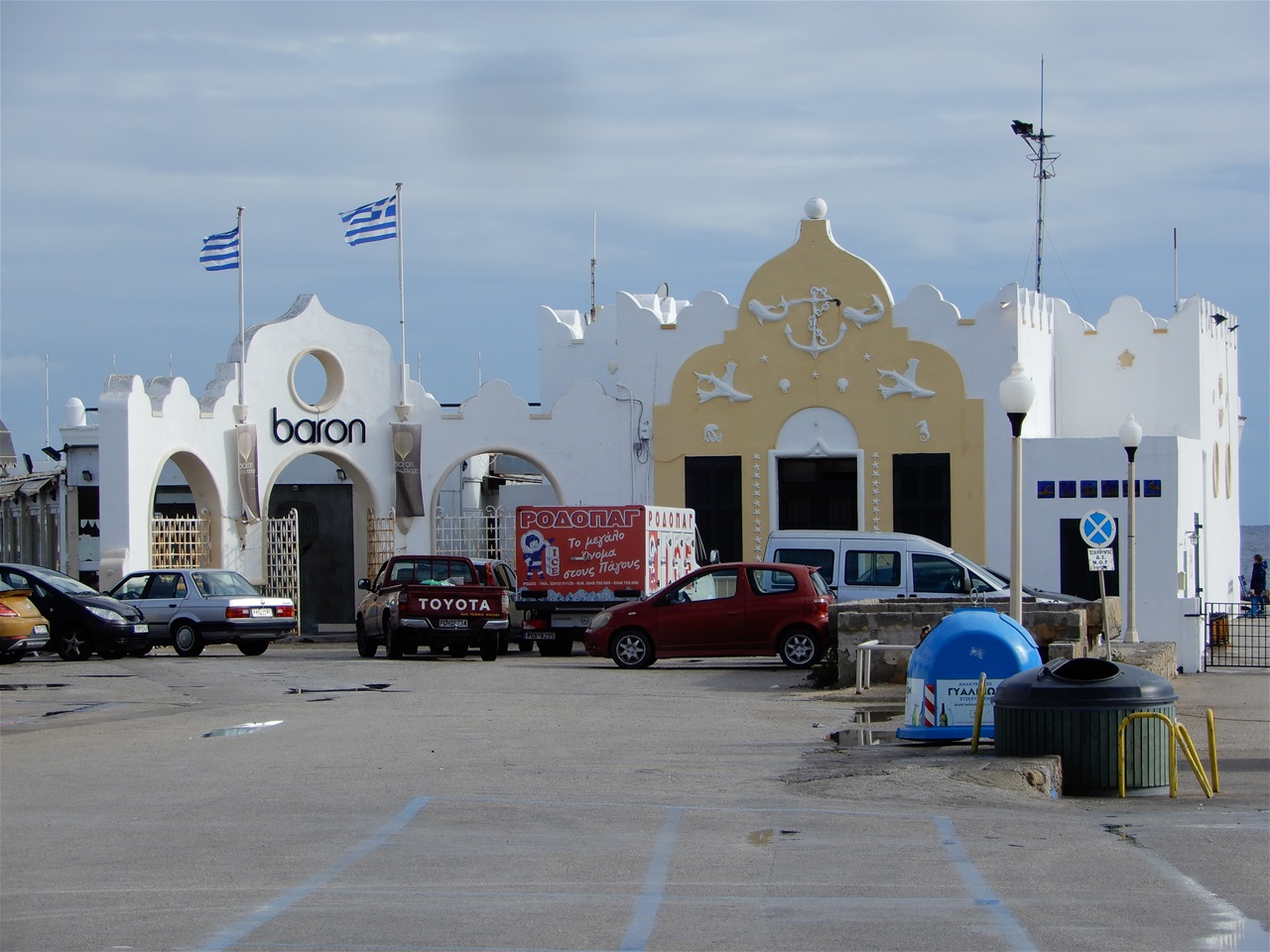
The Rhodos Marine Club.
Today, Elli houses a restaurant, a bar, a beach snack bar and a disco Club. The building next to Elli houses a fish tavern, and the Yaghting Club buliding accomodates a Beach lounge cafe and restaurant.
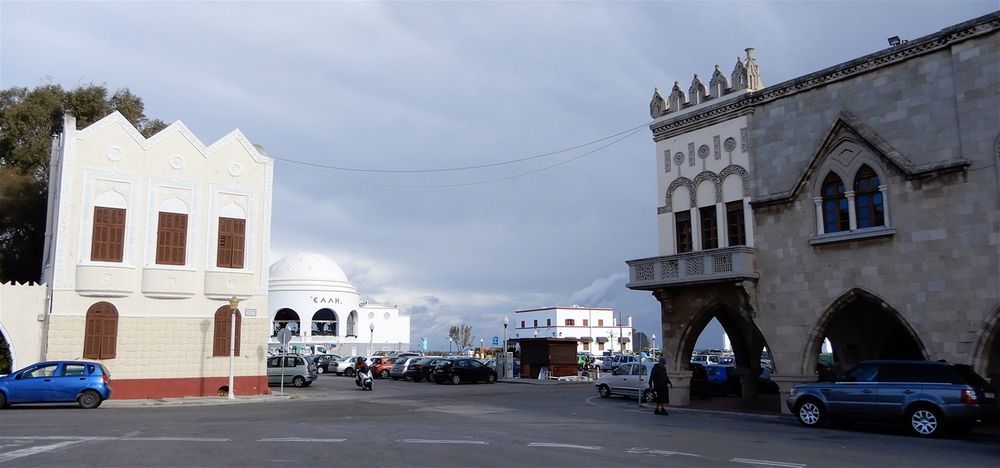
Kountourioti Square seen from Eleftherias Square.
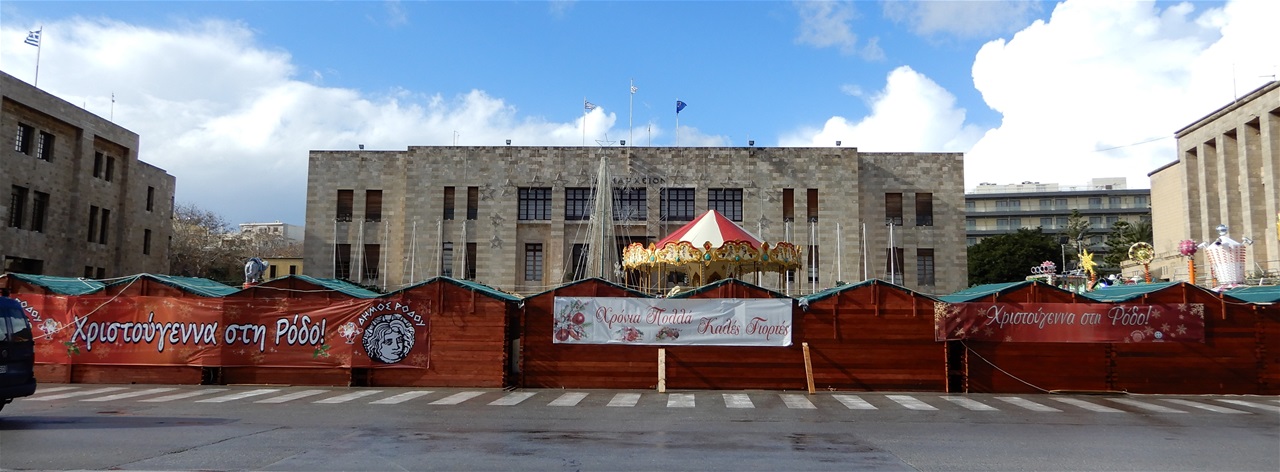
“Eleftherias Square” and the Town Hall in Christmas.
To the south of Kountourioti Square you see the short side of a long building housing the administrative services of the Prefecture of the Dodecanese. The entrance of the building is on the “Eleftherias Square” (former "Piazza dell' Impero" and "Piazza Balbo"), which is surrounded by three important buildings of the fascist period designed by architect Armando Bernabiti: namely,
a) National Theater,
b) City Hall, and
c) Police Headquarters.
❤With Armando Bernabiti, there is a transition to a new generation of buildings in the late 1930s: purer, undecorated, and in every way more minimal and more consonant with the politics of the repressive Governorship of Cesare Maria de Vecchi.
The simplicity is recognizable already in his early (1934) Aquarium building; but his later creations (the Puccini Theatre, the Town Hall, and the church of San Francisco) tend ineluctably toward the military in spirit. It was in this later period that a number of di Fausto’s earlier buildings "renovated" to a new austere form.💔
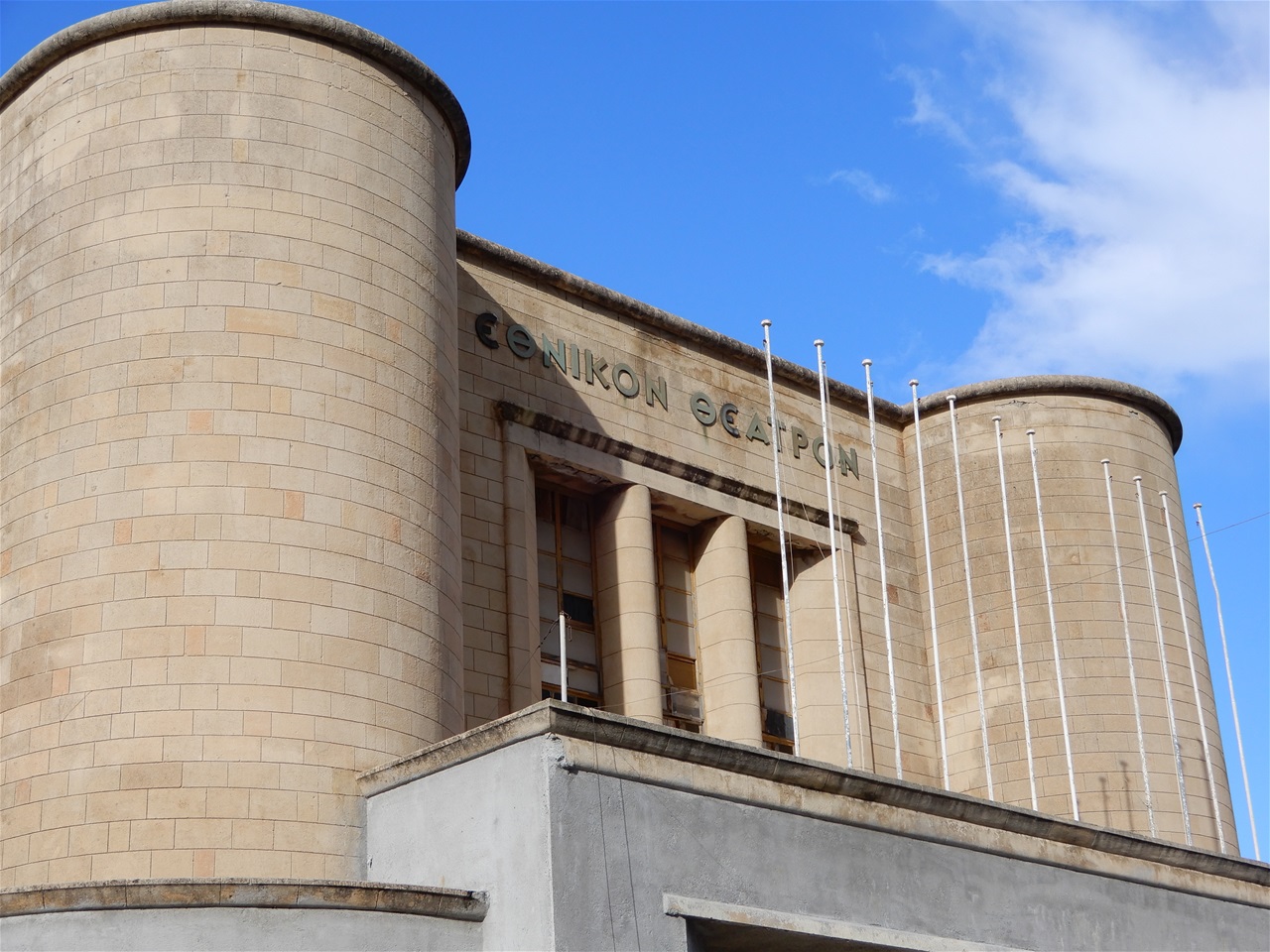
The “National Theater”.
❤The National Theatre impresses with its unique architecture, combining the "International style" and the "Italian (fascist) style" architecture. This is expressed by the cubist mood, simplicity and symmetry, lack of any ornamentation, horizontal openings and much more. For this reason, it is one of the most famous examples of the art of “Finta pietra” with glass blocks in Greece.
The main facade of the theater imitates the great Porta Marina (Marine Gate) of the medieval town. The main hall is impressive with great depth and height and can accommodate up to 1,200 guests. It also features a stunning foyer, luxury boxes and a very large balcony.
a) The National Theater.
The building on the north side of the square is the “National Theater”, originally the “Teatro Puccini”, built in 1937.
The massive theater had its big moments of glory hosting even performances of Italian opera. After the war and the integration of Rhodos to Greece, it continued to function as a theater and cinema in the city.
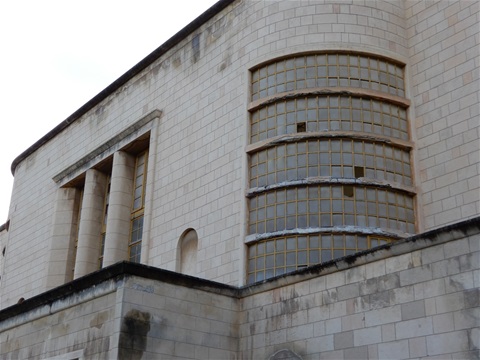
Today, the National Theater is under major renovations, after years of neglect.💔
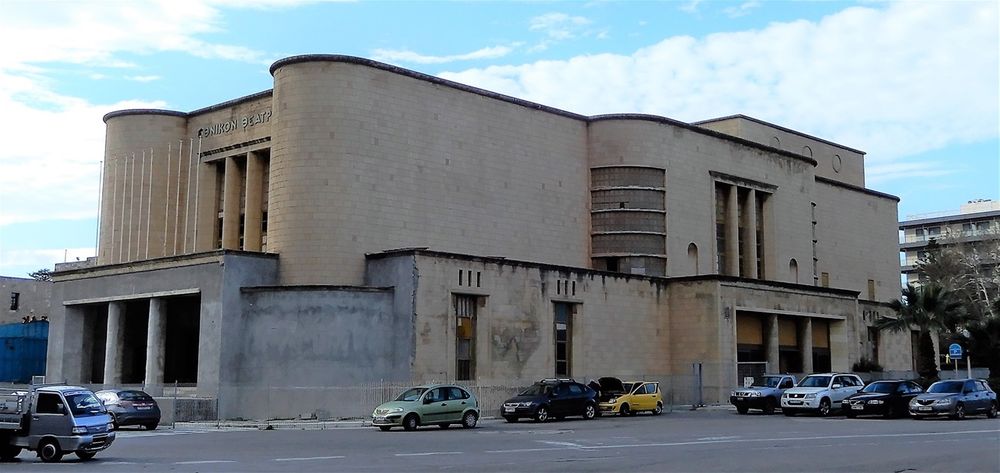
“National Theater”.
b. The City Hall.
The City Hall dominates Eleftherias Square. This edifice was built between 1936 and 1939 under the De Vecchi government, as the “Casa del Fascio" (Fascist Administration Building).
The building in local stone follows the academic schemes of the fascist architecture. In 1939 three statues of Roman emperors, donated by Mussolini, placed in front of the building. These statues are now exposed in the gardens of the Palace of the Grand Master in the medieval town of Rhodos.
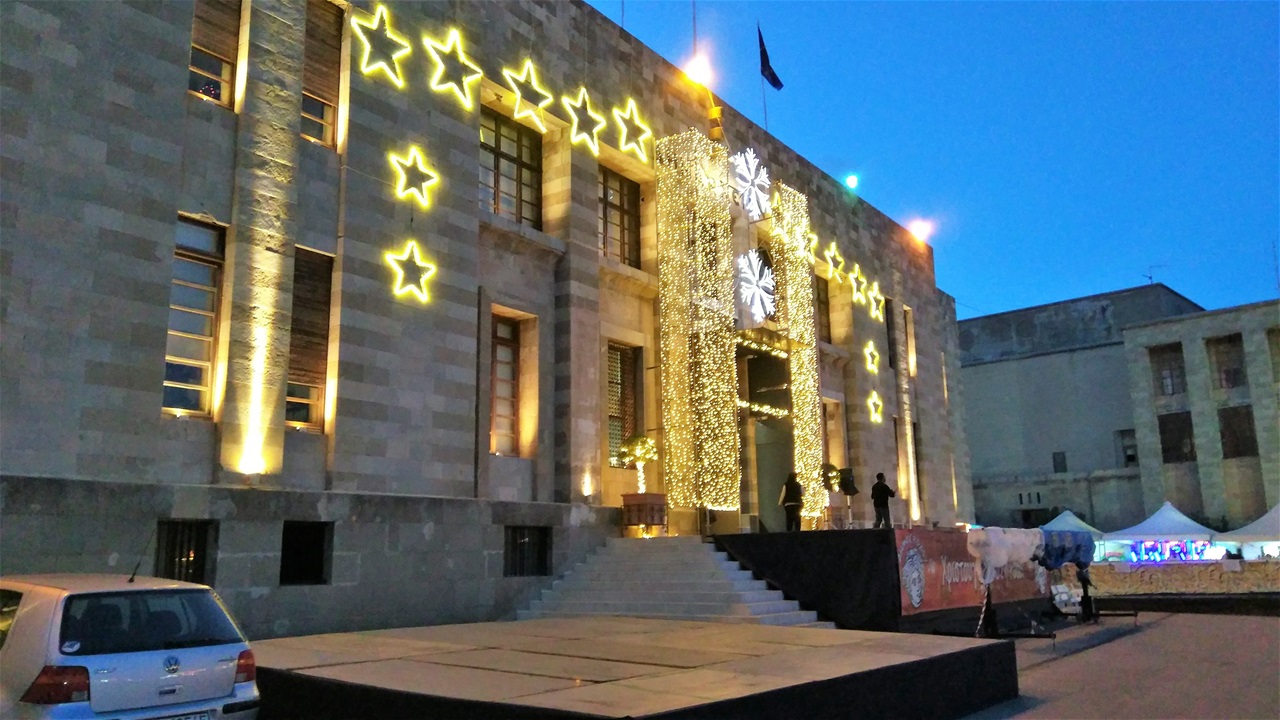
The City Hall decorated for Christmas.
Before the construction of the buildings the Piazza dell' Impero was a racecourse.
The Square is today cluttered with cars.
The Town Hall is well preserved and in its interior one can see original furniture.
The building is accessible to the public and the tourist can grab the atmosphere of an Italian office building of the 40s with lots of shelves, archives, desks, chairs, etc.
On the north side of City Hall Building (1, Efstathiadou str) stands the Municipal Theater “Ροδον”, an open-air theater that stages lots of cultural events during the summer months.
c. Palazzo della Forze Armate.
On the south part of the Square is located the former “Palace of the Armed Forces” (“Palazzo della Forze Armate”).
Today the building houses the Greek Police.
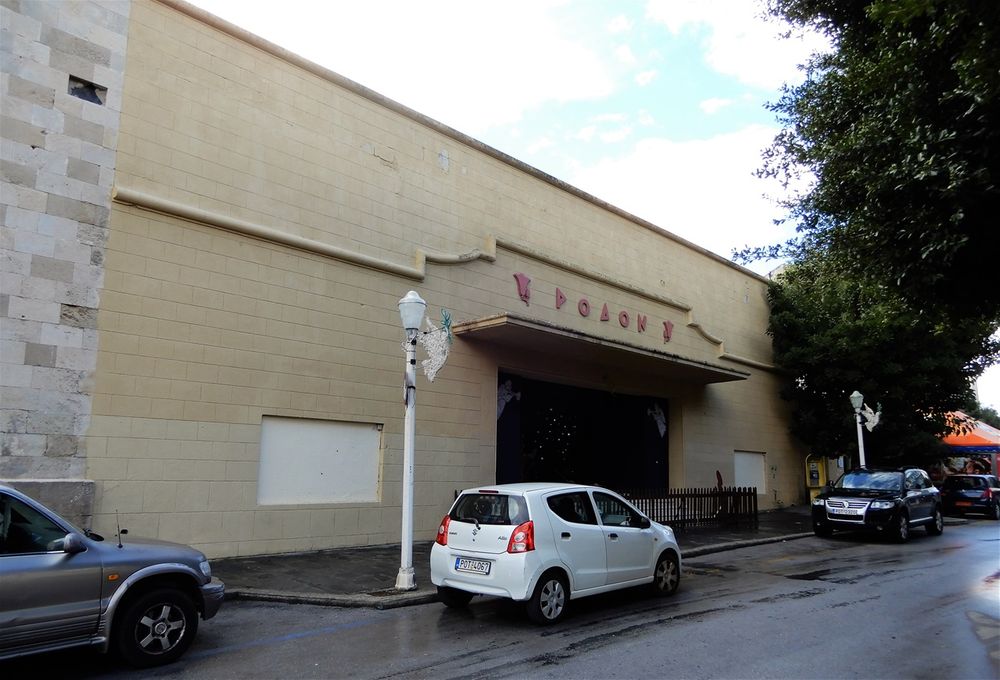
Municipal Theater “Το Ροδον”.
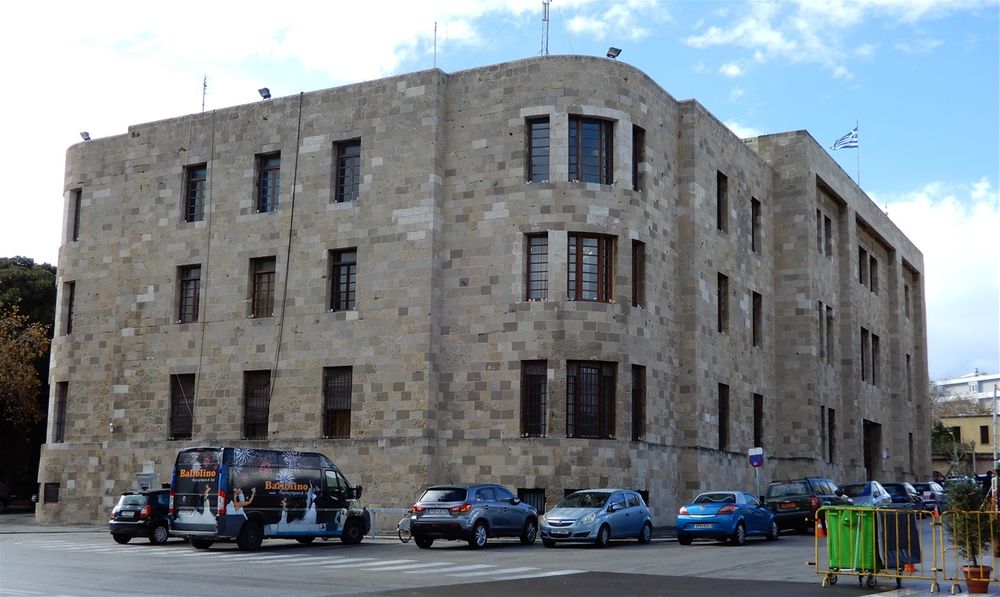
“Palazzo della Forze Armate”.
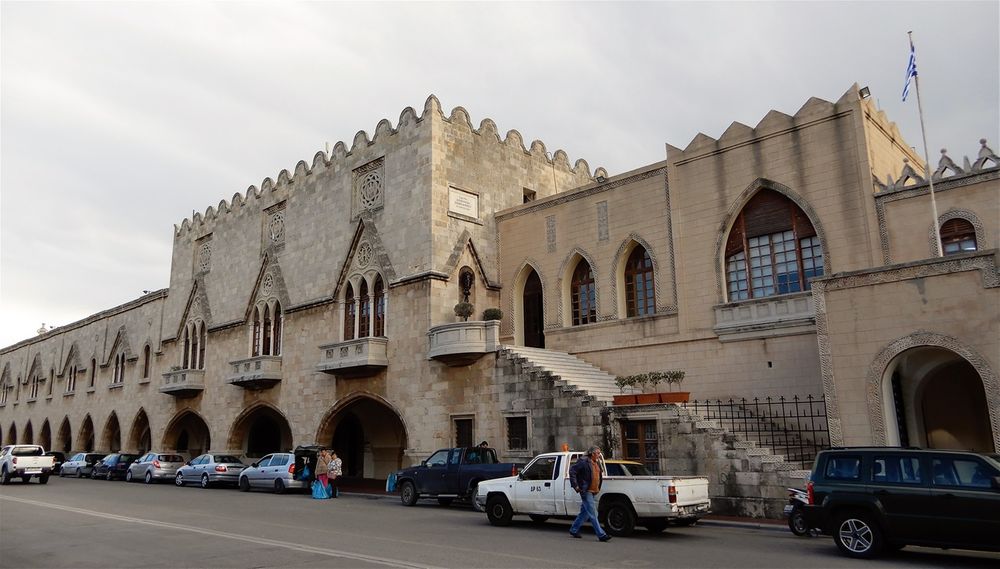
Palazzo del Governatore.
Across the street from Eleftherias Square, imposes the “Palazzo del Governatore”, built in 1927 by Florestano Di Fausto.
The building today houses the offices of the Prefecture of the Dodecanese.
Since located on the beach, the “Palazzo del Governatore” is one of the first images of the city the visitor has, arriving from the sea.
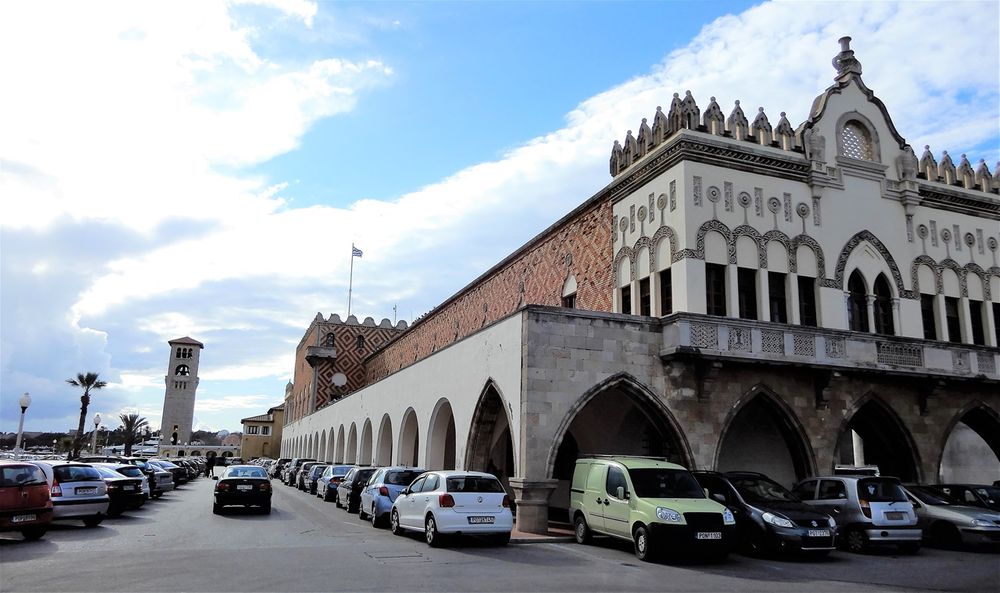
Palazzo del Governatore seen from Kountourioti Square.
❤The architecture of Florestano di Fausto was highly eclectic.
It grafted decorative elements from a variety of origins (Moorish domes, Venetian tracery, Gothic arches, and the clear, cuboid volumes of Aegean indigenous buildings) onto the framework of simple geometric forms favored by ‘Rationalist’ architecture.
It alternates in overall effect between a Crusader military purity at one extreme and an Oriental luxury at the other. Its most characteristic and architecturally courageous feature is the ‘sub merged’ arcade (a broad, generally Gothic arch, or series of arches, supported on very low, stunted columns, which give the impression of having sunk into the ground). The effect is not unpleasing, and accentuates breadth and horizontality over the soaring height customarily associated with the Gothic arch.
The origin of this idea lies in the lower arcade, of the "Palazzo Ducale” in Venice; but it is much exaggerated when it reappears in the port-side arcade of “Palazzo del Governatore”.💔
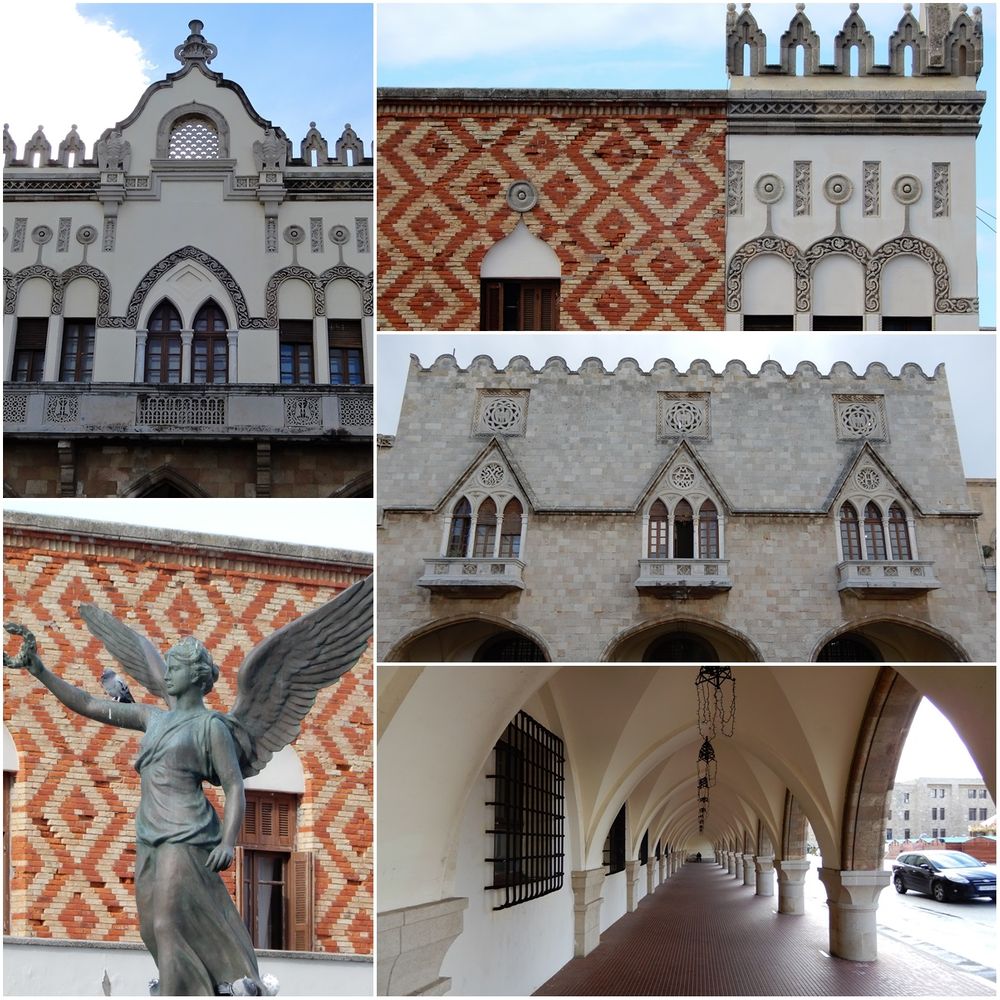
Palazzo del Governatore. The north facede (top left). The east facede (top right, bottom left). West facede and arcade (righ middle/bottom).
At the southern most tip of the Palazzo del Governatore you can see the "Church of San Giovanni" (Saint John), built between 1924 and 1925. The church was designed by Di Fausto and Rodolfo Petracco and is a replica of an older, Hospitallers-era church located just opposite the entrance of the Palace in the Old town, which destroyed in 1856.
Currently the church is readapted internally to the Orthodox Faith. The perfectly preserved church, with its characteristic bell tower and its famed sarcophagi of the Great Magistrates, is now the Orthodox Metropolitan "Church of the Annunciation" (Ευαγγελισμός της Θεοτόκου).
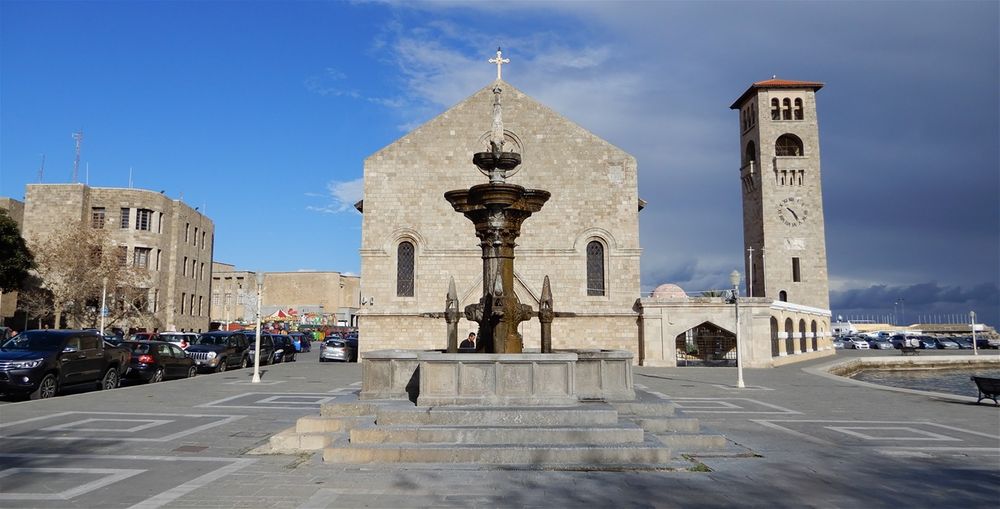
Metropolitan Church of the Annunciation.
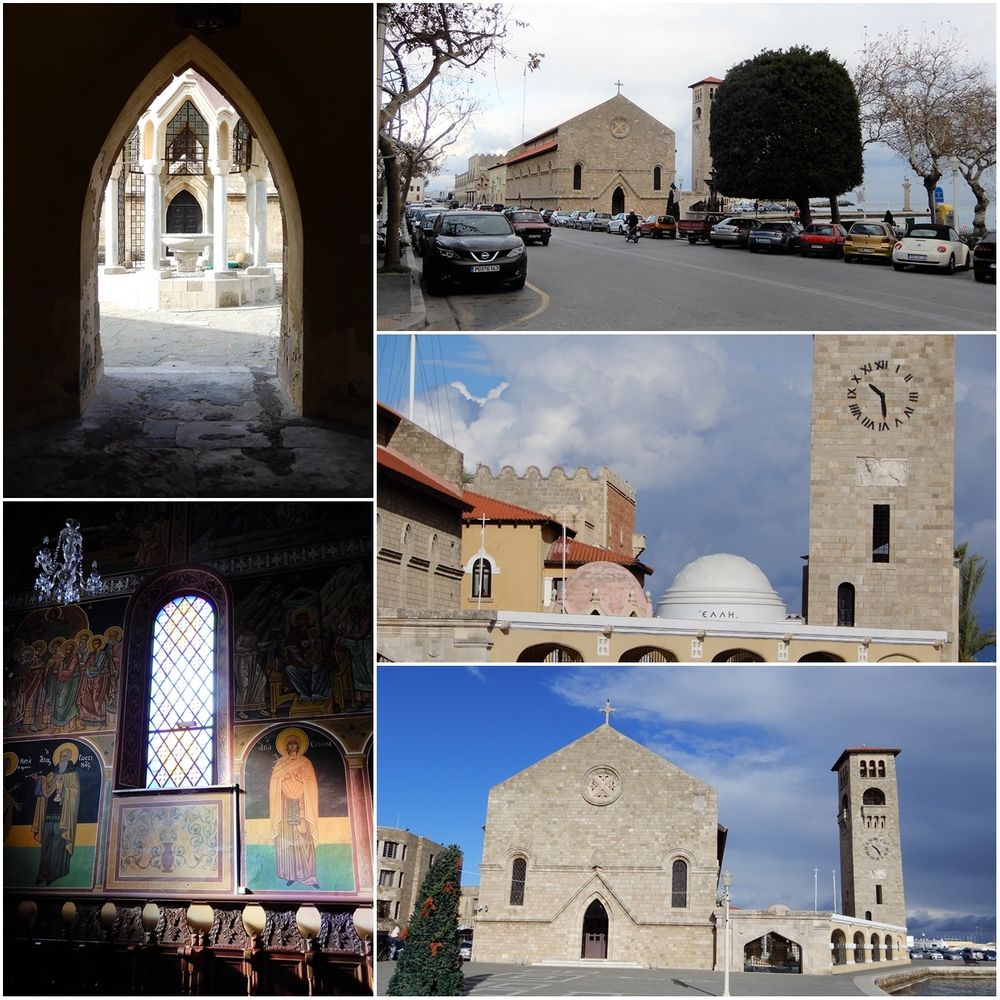
Church of the Annunciation.
Continue south on the main street of Mandraki (7th Martiou str) and on your right hand, just opposite the entrance of Church of the Annunciation, you see the "Main Post Office" (behind the post office are the police headquarters), the "Port Authority Building", and further down the "Courthouse" and the "Bank of Greece".
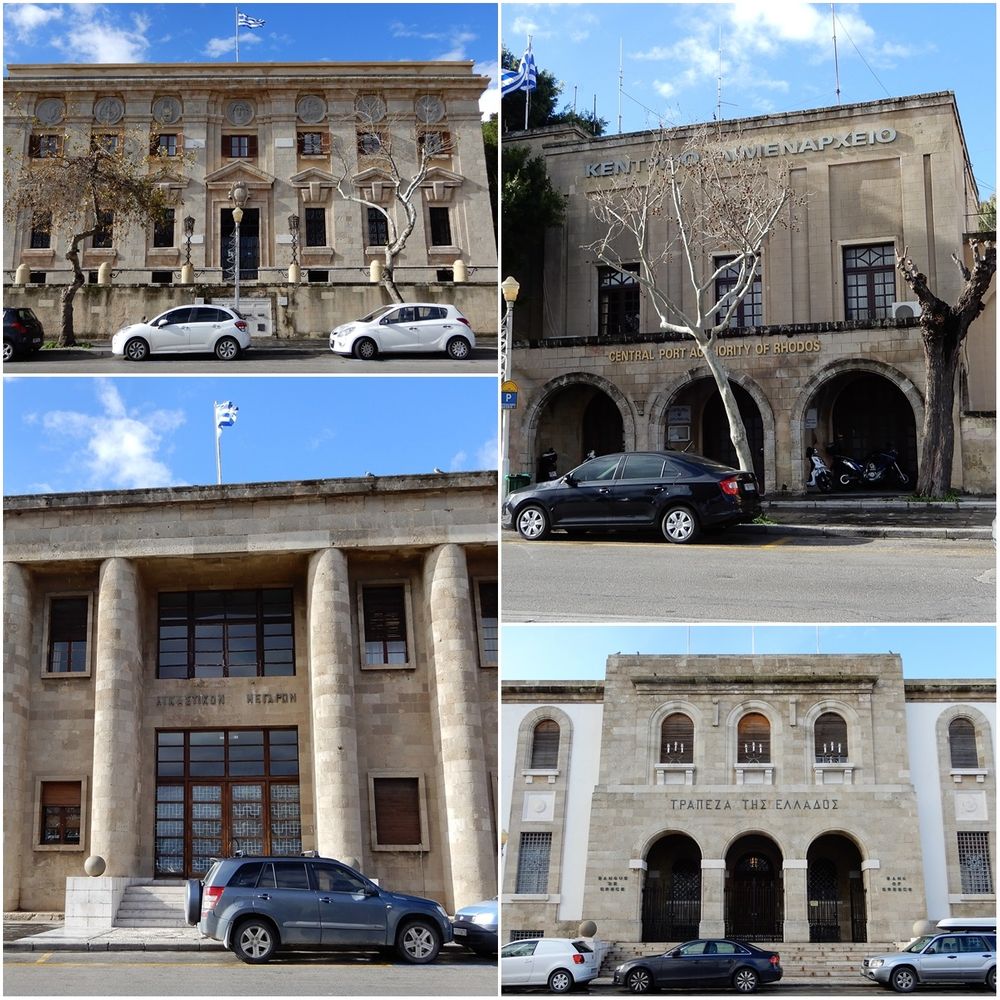
(from top clockwise) Post Office, Port Authority, Bank of Greece, Courthouse.
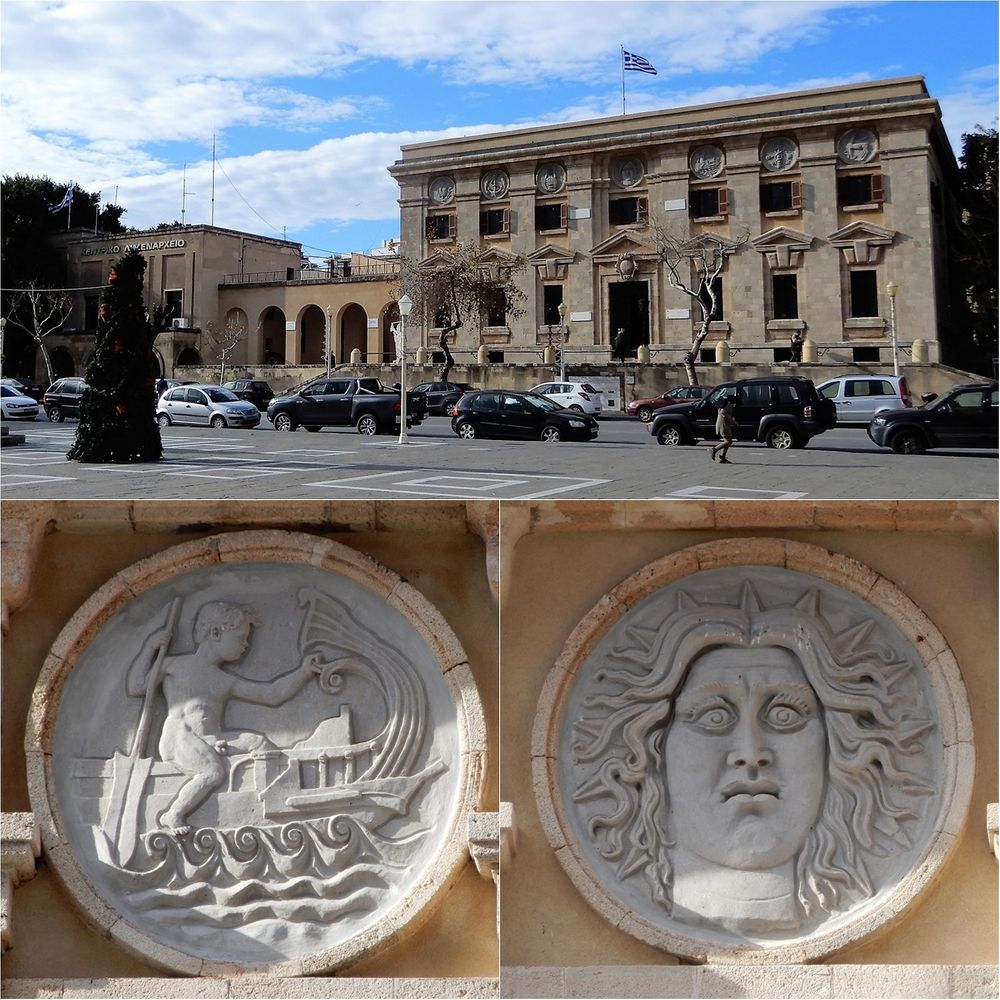
(top) The central Post Office and the Port Authority building. (bottom) Details of the Post Office facade.
Between the Bank of Greece and the Courthouse stands the historical “Aktaion” (Ακταίον) cafe.
❤Aktaion was founded during the Ottoman era as an Officer’s club. The Italians in 1912 renamed the Club in “Circolo d ‘Italia” and it was used again as a Club of Italian Officers and State Senior Officials. They altered the exterior of the building, so it suits the new Italian era.
From 1912 until 1948, all social events took place in the same Aktaion as today. In front of the Italian Club, in the area of Mandraki, parades, musical events, major political, sporting, social and religious events took place, and every Sunday afternoon brides would meet potential suitors and they were then auctioned.
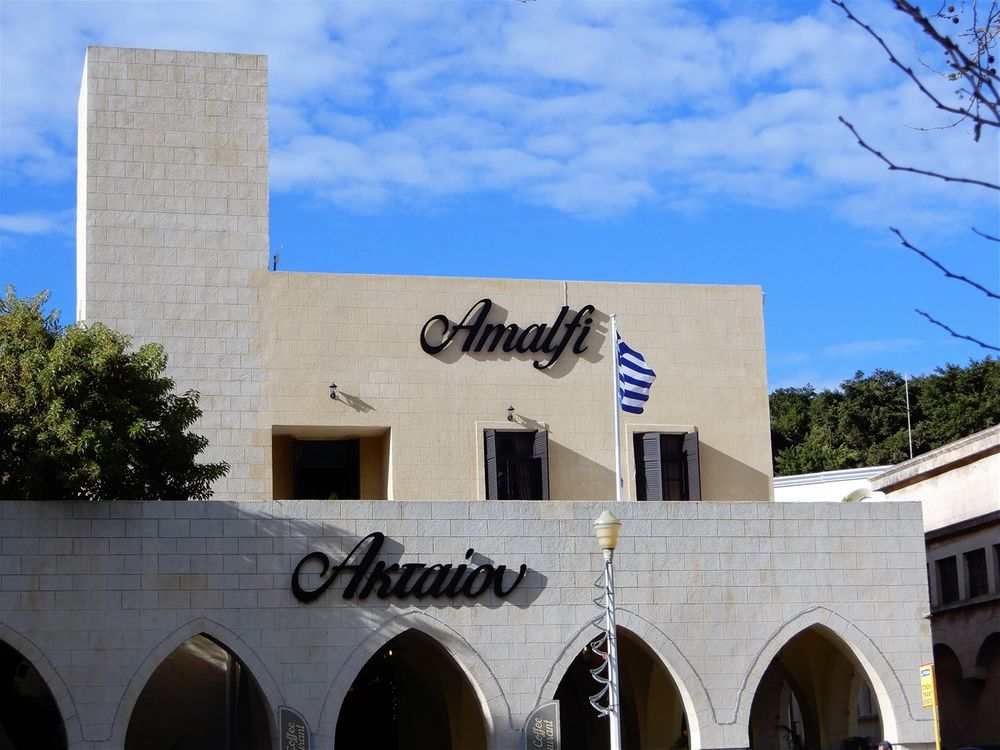
“Aktaion”.
Thousands of young people, children, elders and their families would go there every Sunday to take a walk, eat some ice cream – whilst the young boys would try to catch a hint, a nod or a smile from one of the girls from the villages.💔
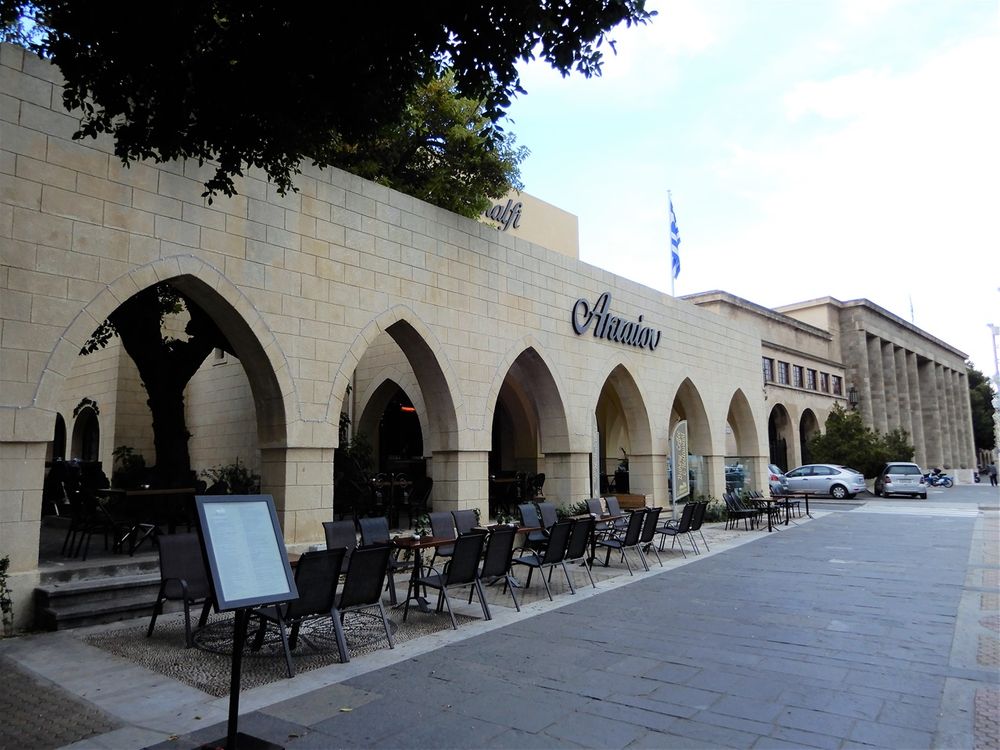
“Aktaion”.
❤Since 1948, all formal political speeches directed to the public, numerous literary, sporting and social events have been hosted at this historic center of Rhodos.
At the time of Liberation (March 31, 1947) and at the time of the incorporation of the Dodecanese islands with Greece (March 7, 1948), all events were centered and targeted at Aktaion, which is so loved and appreciated by the locals and the visitors.
The tree of the beautiful, large and historic courtyard of Aktaion, is also a historic monument. It is called Ficus Benjamina in Latin and “Syke” or “Mikra” in Greek. It was planted on Liberation Day as a reminder of the 5,000-year-old Hellenic Civilization in the Dodecanese!💔
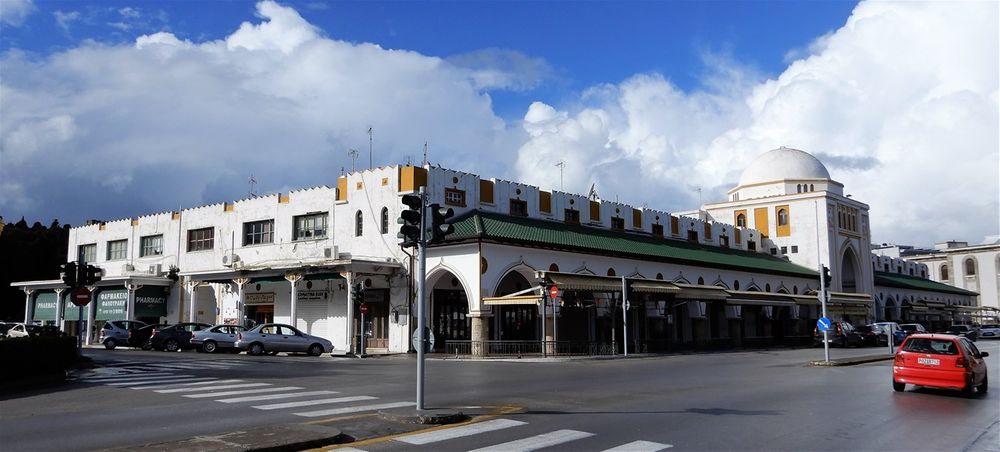
The New Market seen from the Yachting club Cafe at Neorion Square.
Next to the Bank of Greece, and just before the medieval town’s walls, stands the huge hexagonal building of the “New Market” (Νέα Αγορά).
The New market built by the Italians at the place of the older Ottoman Market and features oriental elements and is painted in white and ochre-gold colors.
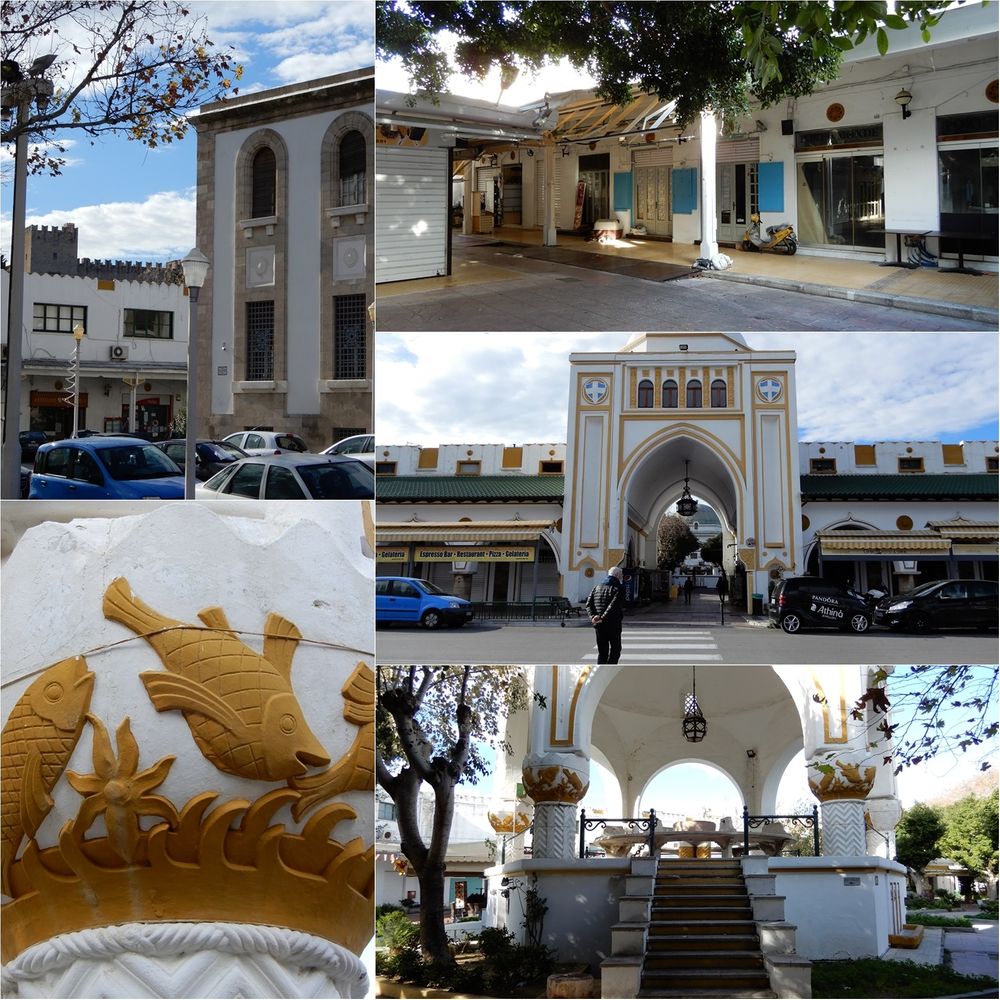
The polygonal white building, opposite the moored yachts and sail boats of the marina, is the work of Fausto and served as the fish market of Rhodos until 1990: it has an outdoor central courtyard where the old fish market was located in the giant gazebo with the fish decorations.
The New Market of today is a remnant of the old glorious and spectacular market. It is left in despair by the authorities and most of the shops have been closed or moved to more shopper attractive places.
The Town Authorities are looking for a new investor who will renovate the market and make it the center of the city it used to be.
The New Market.
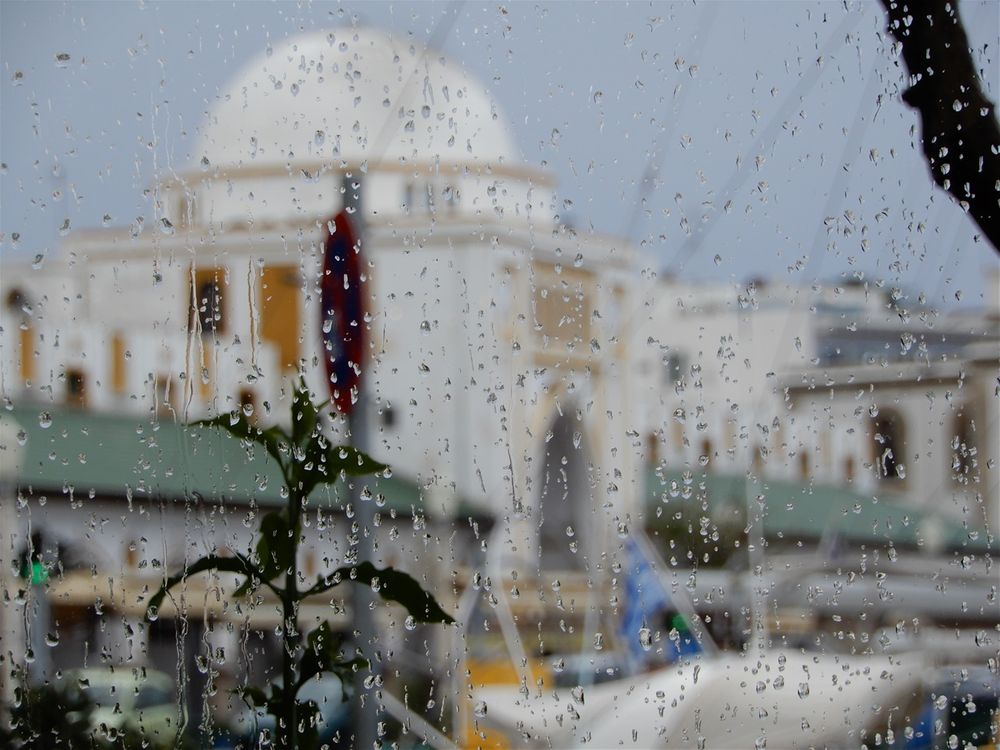
The New Market main Entrance seen from the Yachting club Cafe in a rainy day.
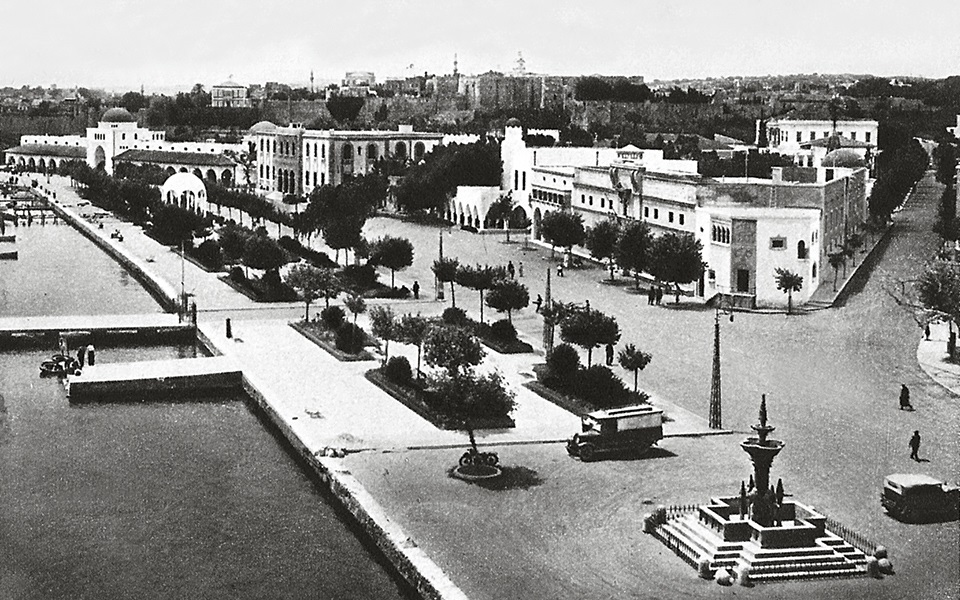
A 20's picture taken from the bell tower of San Giovanni showing the promenade in front of of Mandraki port, where today moor the yachts. At the end of the promenade you can see the New Market and in the background the Palace inside the Medieval Town walls.
Across the street from the New Market is the old port called "Mandraki" separated from the outer commercial harbor by the fortified jetty where three windmills and the 15th century Tower of Saint Nicholas stand (at the end of it).
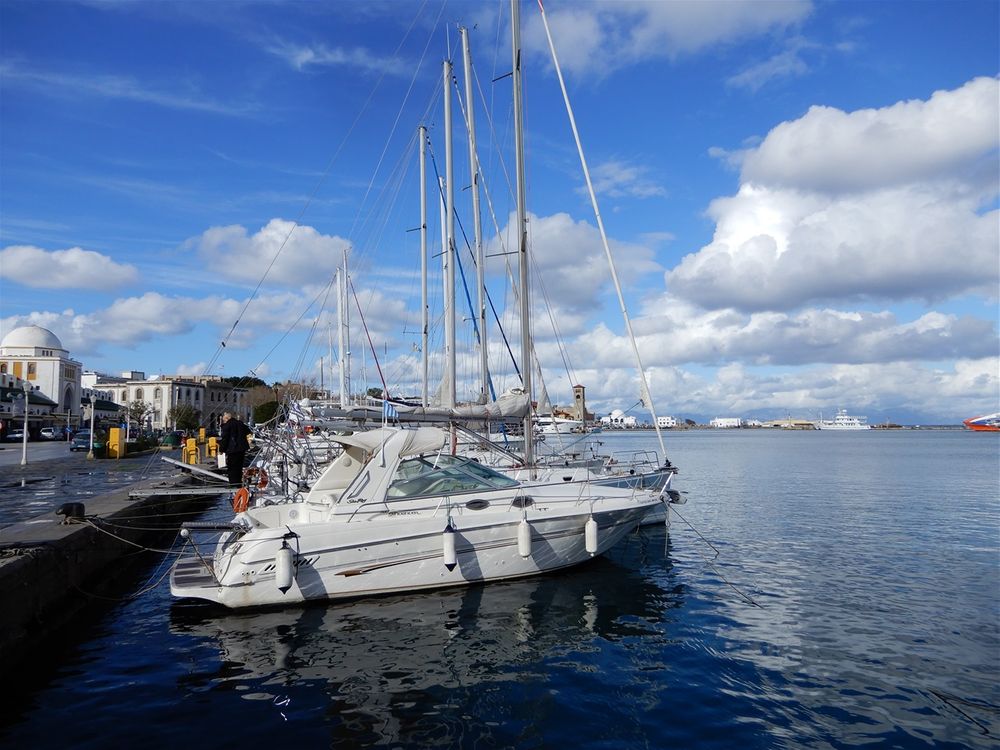
Yachts moored outside New market at Mandraki port.
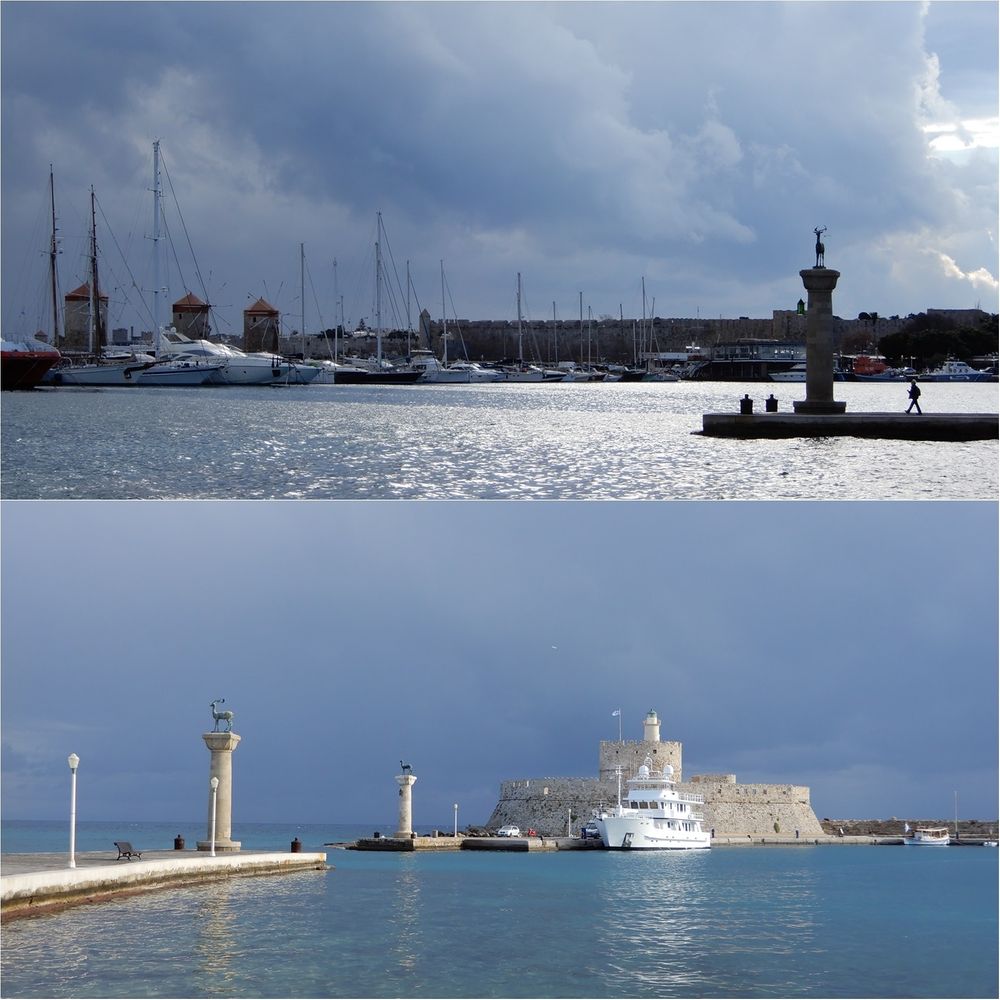
Mandraki Port.
The two deer, one male and the other female which stand on pillars at the entrance of the Mandraki port (harbor)were built by the Italians and symbolize the “platoni”, a local deer species.
The legend says, that the famous "Colossus of Rhodes", one of the seven wonders of the ancient world, was standing at this same position, with his legs spread, so that the boats enter the port by sailing underneath this huge statue.
Between the New Market and the entrance of the Old Town is a shaded park area where, in the summer, street venders sell all kind of souvenirs and local products and portraitists wait to offer their services to the tourists sketching caricatures of them.
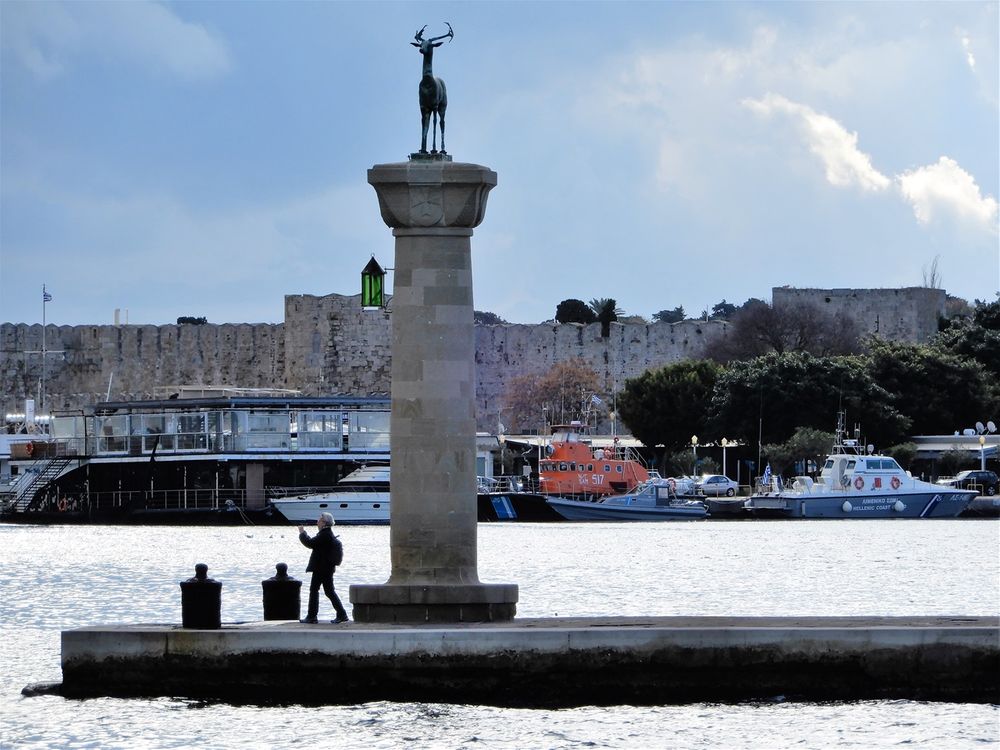
One of the two deer standing at the endrance of Mandraki Port.
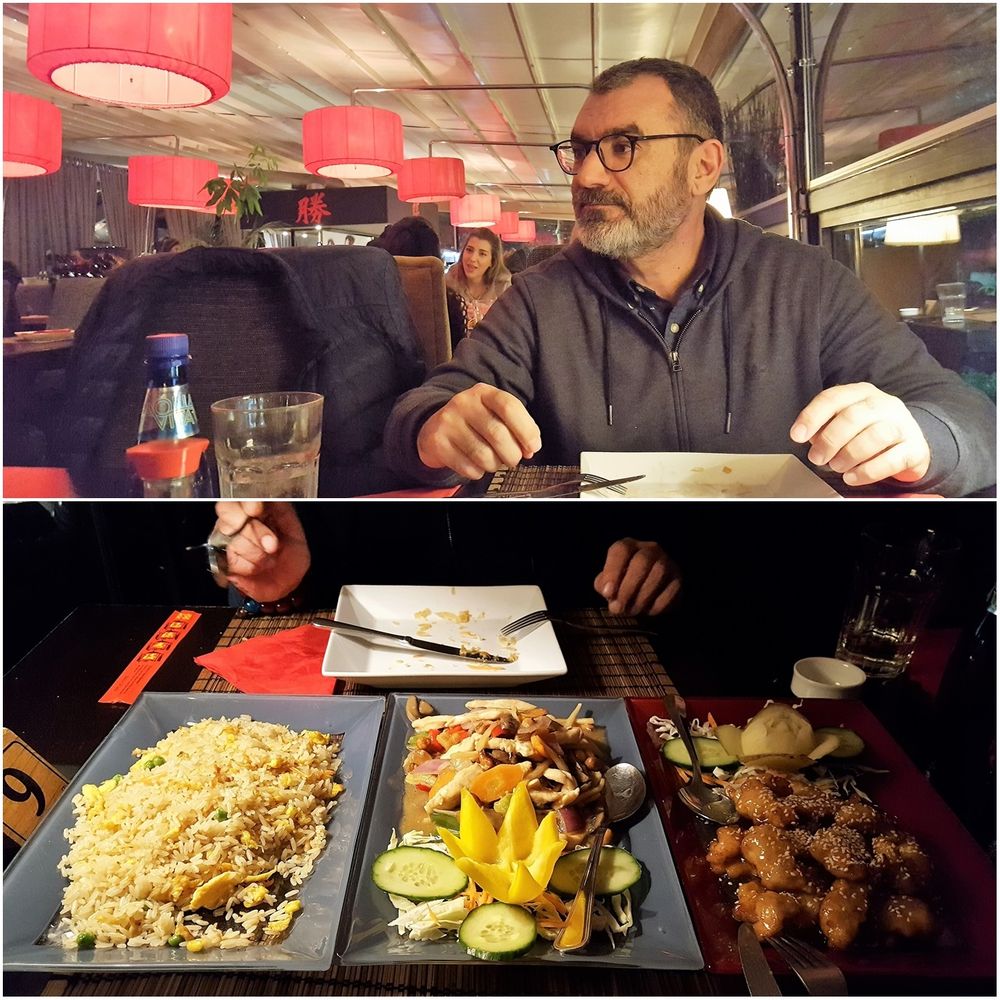
Having dinner at "288 bar&wok" at Therme park.
In front of this park, there is a taxi station.
And this point (where it has started) ends your long architectural walk of the New Town. What is the best way to finish your long day than having a good dinner at “Therme” (inside the Therme Park)? "Therme" is advertised as the only “food entertainment park” … and it is exactly this.
Under the same roof of a modern building, as well as outside in the park, under the lavish vegetation, there is a Chinese restaurant (288 bar&wok), a sushi bar (Rodos Susgi Sowbar), a meat restaurant, a bakery/café (Swedco Café) and much more.
We dined at the place more than once, as it was very well located (just opposite our hotel), but also because the food is very good, the ambience great and the prices very good.
The platoni deer of Rhodos
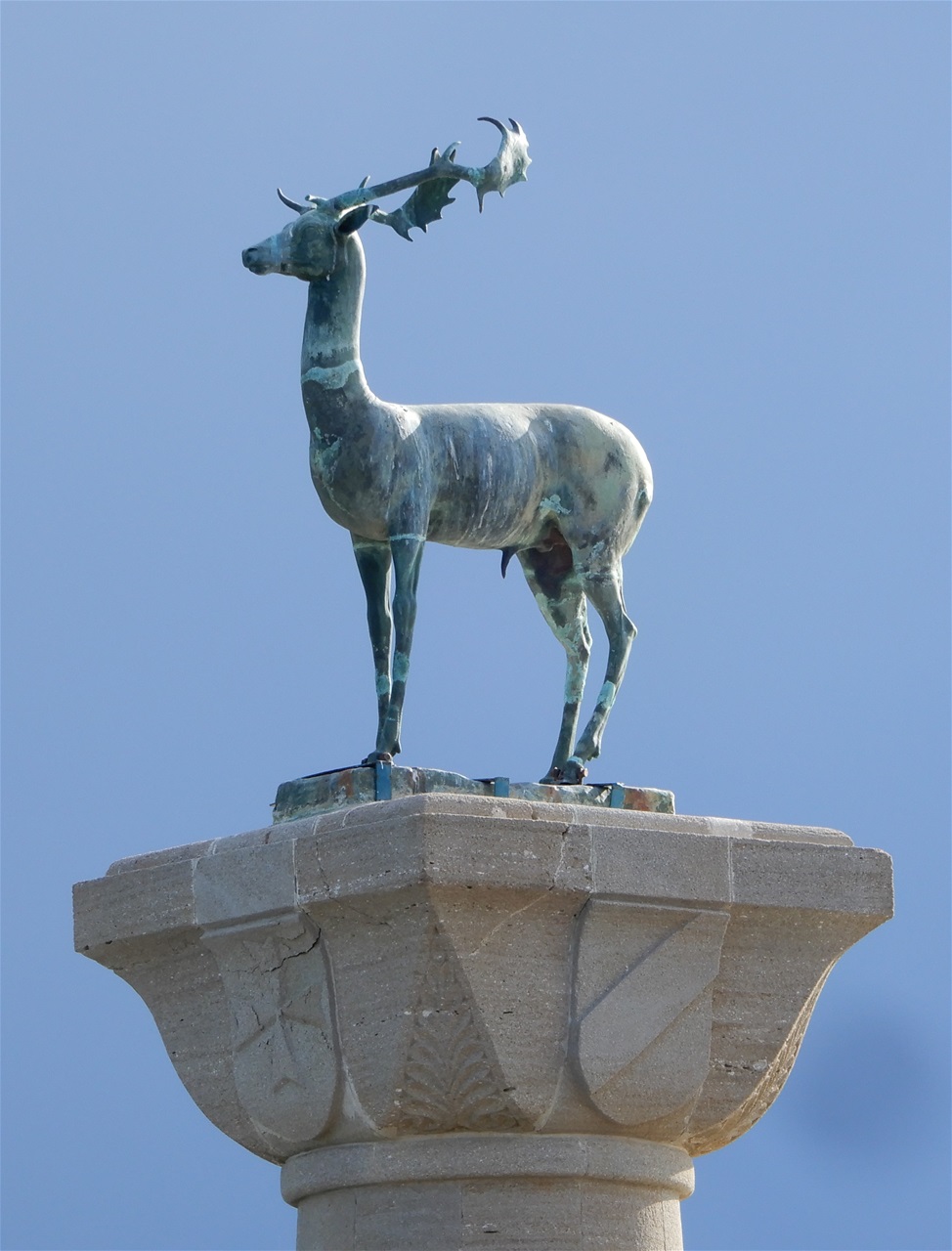
The platoni deer of Rhodes.
❤For many years the platoni, the little deer of Rhodos, that has been considered an emblem of the island, beautifies its forests and is a part of its tradition. It is one of the few deer species in Europe that has survived until today.
There are many popular stories related to the growth and presence of the deer on the island. Many claim that the platoni came to the island of Rhodos with the arrival of the Crusaders. This theory has been correlated with other historical characteristics of the island. Rhodos is referred to in ancient texts as "Ofiusa" which means "having a lot of snakes". According to this theory the Crusaders, in order to protect their camps from snakes, brought the deer to be used as guards. Even though the deer does not hunt to kill snakes, as many believe, it is said that the antlers of the deer secrete an essence, a smell that annoys and drives snakes away. So, some of these animals which the Crusaders brought, escaped from the camps, hid in the forests and later created the existing population.
However, Rhodos is also referred to in ancient texts as "Elafousa" meaning that in those days it had many deer, which naturally existed on the island before all conquerors.
Archaeological findings that indicate the existence of the deer in the East Aegean, are dated back to the 6th millennium BC.💔
The Colossus of Rhodes
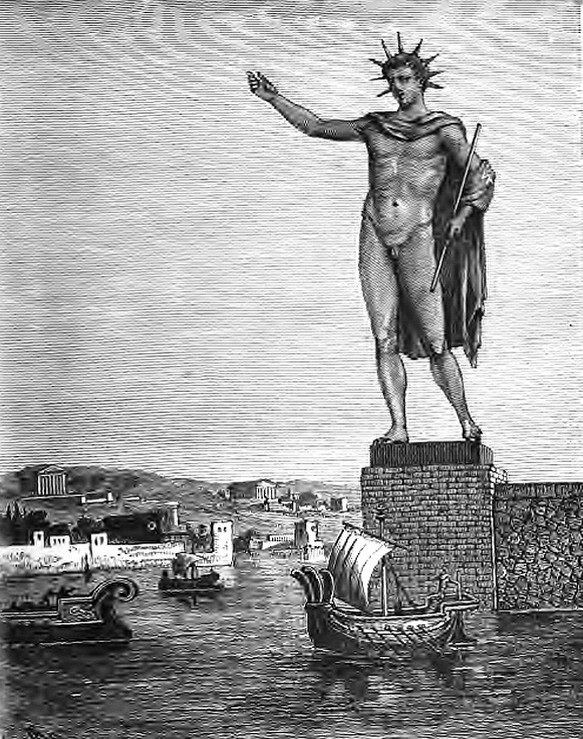
One of the many representaions of "Colossus of Rhodos".
❤The "Colossus of Rhodos" was built between 292 and 280 BC. The statue was a depiction of the Greek Titan Helios (The Sun) and was meant to celebrate the Rhodian victory over the Demetrius Poliorketes (Demetrius the Βesieger) who unsuccessfully sieged the city in 305 BC.
At 30 meters high, the Colossus was one of the tallest statues of the ancient world. It only stood for 56 years until it was destroyed by an earthquake in 226 BC.
When the would-be conquerors οf Demetrius Poliorketes did not manage to conquer the city, left leaving behind much of their equipment. The Rhodians sold the equipment and used the money to build the Colossus and also used brass and iron from this equipment to build the statue itself.
The architect/sculptor of the Colossus was Chares of Lindos.
The "Statue of Liberty" in NYC has been referred to as the ‘Modern Colossus' and has more or less the same height as the ancient Colossus. "The New Colossus” (1883), a sonnet by Emma Lazarus engraved on a bronze plaque and mounted inside the pedestal of the Statue of Liberty in 1903.
Ptolemy III, the king of Egypt, offered to pay for the Colossus' reconstruction, but the Rhodians refused. They believed that God Helios himself was angered by the statue and caused the earthquake that destroyed it. The Rhodians were conquered by the Arabs in the 7th century A.D. The Arabs dismantled what was left of the Colossus and sold it as scrap metal. This is most probably the reason we haven't find any remnants of the statue till today.
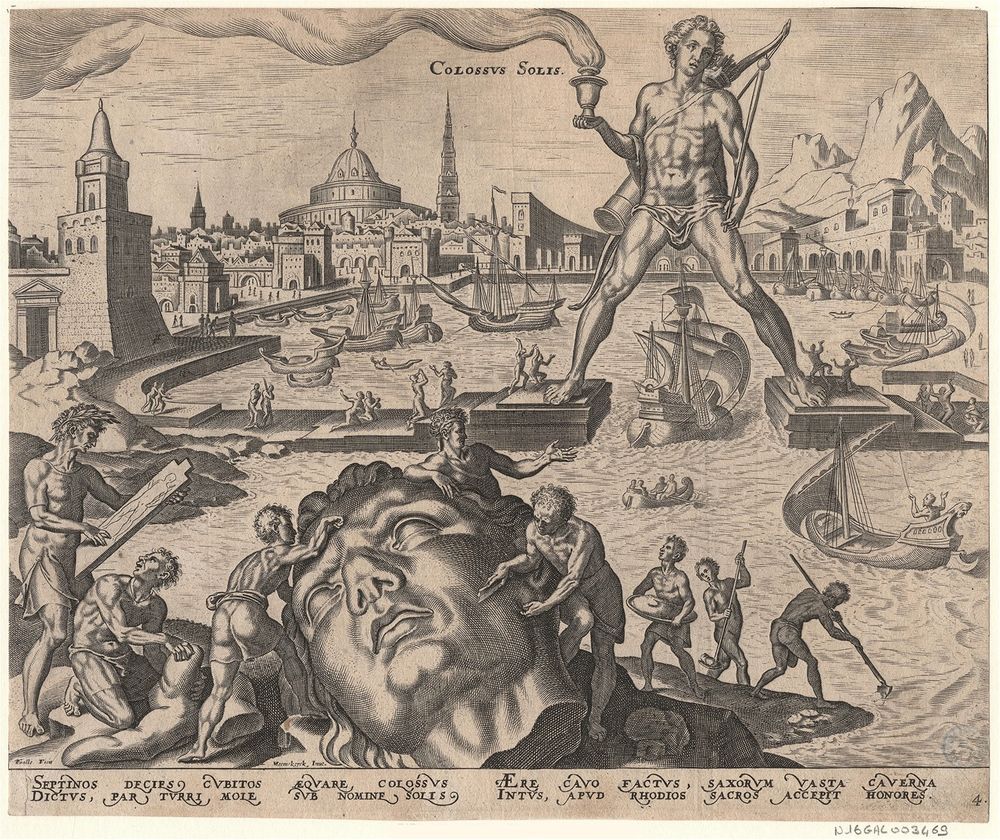
A gravure of the Colossus (from the series "The Eighth Wonders of the World") after Maarten van Heemskerck, 1572. Today in the collection of the Museum Boijmans Van Beuningen, Rotterdam.
A gravure of the harbor-straddling Colossus.
The harbor-straddling Colossus was a figment of medieval imaginations based on 14th centure texts noted the local tradition held that "the right foot had stood on land and the other in the sea". Many later illustrations show the statue with one foot on either side of the harbor mouth with ships passing under it. References to this conception are also found in literary works (e.g. Shakespeare's “Julius Caesar”).
While these fanciful images feed the misconception, the mechanics reveal that the Colossus could not have straddled the harbor as described above.
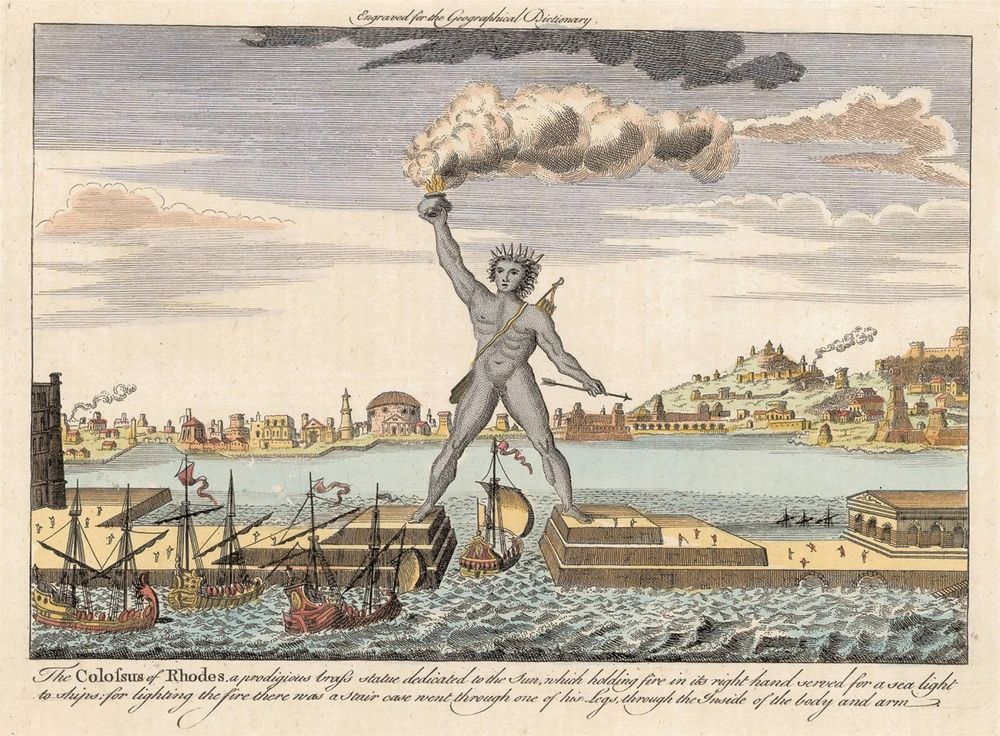
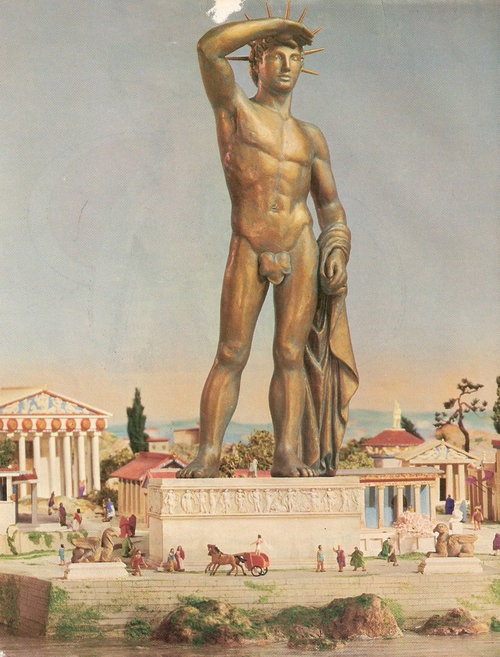
The Colossus of Rhodes, by Patrimonios Del Mundo.
If the completed statue had straddled the harbor, the entire mouth of the harbor would have been effectively closed during the construction, and the ancient Rhodians did not have the means to dredge and re-open the harbor after construction. Even neglecting these objections, the statue was made of bronze, and engineering analyses indicate that it could not have been built with its legs apart without collapsing from its own weight.
While scholars generally agree that anecdotal depictions of the Colossus straddling the harbor's entry point have no historic or scientific basis, the statue's actual location remains a matter of debate. Some postulate that the Colossus was not located in the harbor area at all, but rather was part of the “Acropolis of Rhodes”, which stood on a hill that overlooks the port area. Others believe that the statue was standing further south, outside the “Marine Gate” of the Medieval Town, or at the mouth of “Kolona-Fishing Harbor”.💔